





In an era when weather patterns were predictable and temperature changes were not as drastic, the dark-grey clouds before a hailstorm or rainfall brought with them a looming warning. The arrival of Barzangi, a dark giant of immense power, has the ability to regenerate its head seven times if decapitated. People who were once terrorised by Barzangi upon the arrival of rain now fear whether Barzangi will be able to survive the deafening hailstorms and unpredictable rain.
Across regions, some folktales are embedded in the weather patterns. The arrival of certain mythological creatures illustrated the predictability of weather. Developing an understanding among residents that hailstorms would bring dark giants and spring would bring forth fairies. However, the greenhouse gas emissions have gradually forced these legends into a deep slumber.
Climate Change and Emitters
Scholars have noted that the rise in Earth’s temperature began in the 1800s with the advent of the ‘Industrial Revolution’ in Great Britain. As per the reports of the US Environmental Protection Agency, the developed countries — the US, Russia, China and the European Union — are responsible for approximately 67% of global greenhouse gas emissions. The irony lies in the fact that the consequences of climate change have affected the global south more severely than the global north.
Similarly, a recent study warned about the sharp rise in mortality rate due to increasing temperatures. According to the projections, Pakistan and Burkina Faso would be severely affected. Although there are several international frameworks aimed at curbing emissions and adapting to irregular weather patterns and financing capacity-building measures, such as the Paris Agreement, Sustainable Development Goals and UN Framework Convention on Climate Change, to name a few.
Is the Paris Agreement Achieving its Goals?
Before debating the effectiveness of the Paris Agreement. We should first understand its core values and mission. The Paris Agreement is a legally binding international convention addressing climate change. Its main objective is to keep the rising global temperature well below 2°C above pre-industrial levels and to work to limit the temperature increase to 1.5°C. It works in a five-year cycle, where countries submit nationally determined contributions (NDCs) to explain their plan to combat climate change based on adaptation and financial flows. Moreover, the agreement provides financial, technical and capacity support to countries more prone to climate disasters.
One may imagine that in a multipolar world, an agreement like the Paris Agreement, which ties multiple states together to work towards a particular climate cause, would work impeccably; however, it could not be further from the truth. Wars and energy crises have drastically increased greenhouse gas emissions in the multipolar world order.
Interestingly, the Paris Agreement does not demand a full disclosure of military emissions, and while submitting a report on NDCs to track progress is mandatory, its implementation is non-binding.
The loopholes within the treaty have made its effectiveness questionable. So, if these loopholes are not filled in time and states parties to the treaty continue violations. The treaty would become obsolete over time.
The Urgency
In contrast to the ideals of the Paris Agreement, Pakistan is surpassing the climatic limits set for 2030. The insufficient domestic climate policies, coupled with the ongoing war nexus in the neighbourhood, have turned out to be pertinent causes of aggravating climate change.
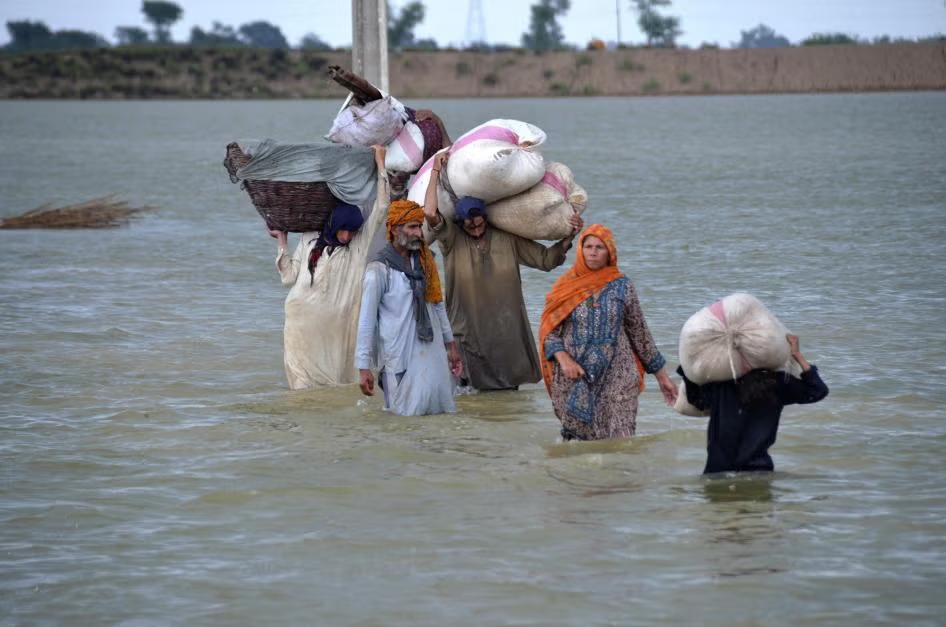
The catastrophic floods of 2022 in Pakistan were supposed to be a wake-up call for the country and for the entire Global South. To understand the climate debt and work together with the Global North to develop resilient and sustainable infrastructure.
In order to lessen the impact of future climatic shocks. But the current situation and the energy crisis of 2026 have made it evident that regress is swifter than hope for progress. As states are starting to return towards fossil fuels to meet the demand for energy in the wake of the energy crisis.
Standing at the Cross-Roads
For states like Pakistan, climate change is no longer a mere threat. It has become a ticking bomb, threatening the survival of the state and the people living within it. Pakistan needs to develop green policies divided into short-term and long-term goals over a course of time, monitored with strict compliance by the relevant authorities.
Right now, Pakistan needs to create sustainable infrastructure, such as creating pavements for stormwater and developing and strengthening its wind and solar power structures. In this regard, Pakistan can seek help from China, as it is considered the undisputed state to develop wind and solar power. Besides, China has created proper and effective systems that produce, store and distribute clean energy.
On the other hand, in the long term, Pakistan requires effective green policies and frameworks that would stand the test of time and political upheaval. EU countries are considered torch-bearers in this particular domain, such as the European Climate Law of 2021, which made it legally binding on states to reduce 55% of greenhouse gas emissions by 2030, and the Circular Economy Action Plan of 2020, by targeting industries with high resource consumption — electronics, batteries, textiles and plastics — and focusing on creating goods that are robust, reusable and recyclable are a few among other initiatives.
Hence, the carbon market deal between Pakistan and Norway can be an opportunity to branch out into the EU. Even though Norway is not part of the European Union, it can act as a facilitator for Pakistan to initiate dialogue with EU countries, and in turn, Pakistan, via leveraging diplomatic ties, it can develop effective green frameworks in the form of green economic and sustainable deals.
If Pakistan focuses on mitigating climate risks, the cost of human toll as a result of climate change will drop significantly. Perhaps, by actively catering to the impacts generated by climate change, the dark giants could be seen once again, and fairies could finally travel to warmer regions.