





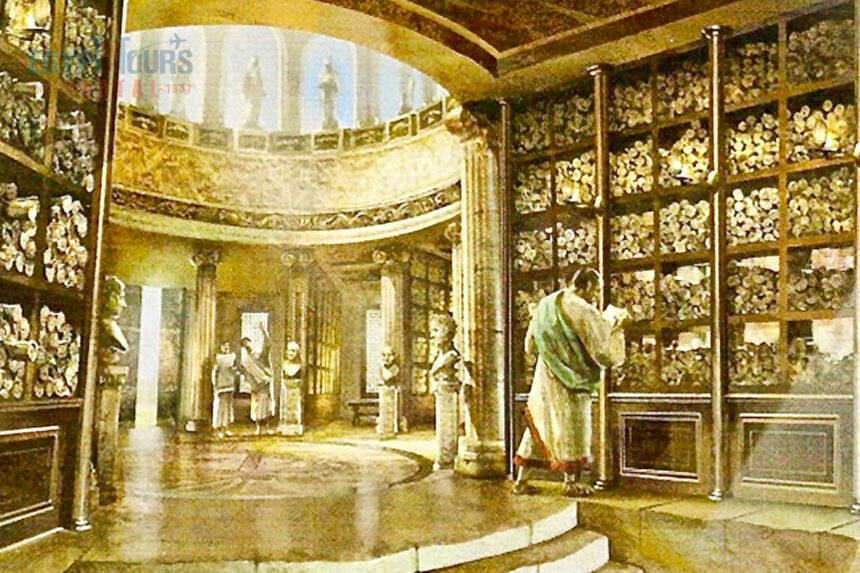
The Library of Alexandria has become almost legendary in the annals of humankind. Just say its name, and you’ll instantly envision endless scrolls, burning shelves, forgotten civilisations, and knowledge dissipating under an old-time sky. It has evolved beyond its status as a library. It’s come to symbolise everything that humans have made and everything that they haven’t protected.
For centuries, the sad notion has been repeated: the library was the largest body of knowledge in the ancient world, and it all burnt to the ground with the knowledge that could have changed civilisation forever.
However, what did the world lose?
The solution is not only more complex but also more disturbing than legend portrays.
Under the rule of the successors of Alexander the Great, the Ptolemies, sometime during the 3rd century BC, the city of Alexandria was founded with the Library of Alexandria. The city of Alexandria itself was meant to be a hub of commerce, politics, philosophy, and learning, a place where the ideas of the Greeks, Egyptians, Persians, Jews, and others could meet.
The library was part of an institution that was known as the Mouseion, or “Temple of the Muses,” and operated somewhat like an ancient research academy. They were the homes of scholars, students, debaters, and writers. The Library of Alexandria was a library built primarily to preserve the works of the known world, unlike modern libraries that are created for public use.
It was an unprecedented desire.
According to the legend, ancient rulers sent agents to buy manuscripts from all over the ports and cities. Books were sometimes confiscated from ships arriving in Alexandria and were copied and stored in the archives. Mathematics, astronomy, medicine, drama, philosophy, engineering, poetry, and geography were all brought to the city.
The library was revolutionary, with the notion that all human knowledge could be housed there.
Geography, language, and empire divided the ancient world. Knowledge travelled slowly. Handwritten copies of texts were made. Removing traditions at the stroke of a single fire, flood or invasion. In such a world, Alexandria was the greatest attempt at intellectual preservation by humanity.
However, the actual myths people have about the destruction of the library outweigh the facts.
Popular conception of a single disaster — one big fire that incinerates everything. But, according to history, the drop is much more gradual. The collection may have been damaged while Julius Caesar campaigned in Alexandria in 48 BCE. Over the centuries, there were political upheavals, religious warfare, shifting imperial agendas and eventual decay of institutions, all of which may have played a role.
That is, the library likely did not go out of existence on one spectacular night.
It disappeared gradually.
The gradual vanishing might be more terrifying than the tale itself. Collapse tends to be thought of as a sudden and visible event in civilisations. Yet time and time again, cultural decline has taken place through neglect, disintegration and silent erosion of institutions.
Yet, what was it that was actually forgotten?
Actually, no one can say for certain.
This ambiguity has given rise to an abundance of rumours. Some envision that with the destruction of the library came the sophisticated science, maybe even the ones developed centuries in advance. The loss was enormous, although many of these claims were exaggerated.
The ancient literature revealed devastating gaps. There are many Greek tragedies from the ancient period, but only a few have survived. Many works have been lost, but their names are known to historians. Many schools of philosophy are still known to us only through the words of subsequent authors.
This also holds true for scientific and historical texts.
In Alexandria, ancient scholars were highly proficient in the fields of astronomy, geometry, medicine, engineering and geography. Many people studied in Alexandria, or had a connection to Alexandria, including Euclid, Archimedes, Eratosthenes, and Herophilus. Eratosthenes measured the circumference of the earth with remarkable precision, and Herophilus did anatomical research much before the later medical practices in Europe.
How many of the like-minded ideas were lost?
No one can say.
Yet perhaps the biggest loss wasn’t of books per se.
It may have been a continuity thing.
Preservation is a way of advancing human knowledge, along with discovery. Civilisations are made by previous generations. Without knowledge, some societies are compelled to learn what they used to know.
But the tale of Alexandria also holds out a glimmer of hope for humankind.
Throughout history, archives have been destroyed, universities have collapsed, and systems of learning have been shattered, but humans have always rebuilt. The reason why knowledge is perpetuated is that people have opted to keep it.
Today, the world has methods of information storage that the ancient world could not have dreamed of. The amount of information in digital archives is greater than what any ancient library ever had. However, contemporary societies are still at risk, albeit in different areas: misinformation, censorship, technological dependence and the load of information.
This lesson in Alexandria is very modern.
Civilisations are not only assessed by what they produce but also by what they decide to retain. Hence, the power of the image of Alexandria remains with us after over two millennia. The importance of ancient scrolls is not just about ancient scrolls. It’s a fear that what they know can be lost, a human fear.
Today, the Library of Alexandria is not a building but a warning. It was not just books that were lost there. It took us all its voices, its questions, its debates, its discoveries, and its possibilities, which we may never come back to.
Not only parchment could have been the object of flames, slowly or suddenly.
It was one of the memories of mankind.