





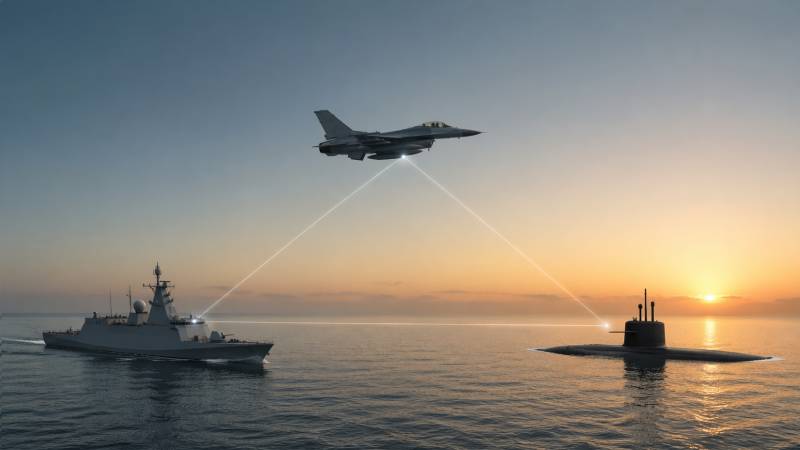
The term ‘interoperability’ was coined in the late 20th century, but was in practice before it was given a name. The World Wars saw interoperability between allied countries. Recent war theatres have demonstrated interoperability’s crucial role in drawing up a common operational picture. Marka-e-Haq was one such theatre wherein the interoperability between the Pakistan Air Force (PAF) and the Pakistan Navy (PN) was on full display.
The presence of spokespersons from Pakistan’s three services during briefings and press conferences became a powerful representation of interoperability, reifying the notion from an abstract principle into an emblem of collaboration. It was equivocally stated by PN’s spokesperson that close and effective coordination took place between the PAF and PN, particularly in connection with the movement of the Indian aircraft carrier, INS Vikrant.
Carrying only eight to 12 MiG-29 aircraft on its deck, termed as insufficient for carrying out the air defence of the carrier itself, the carrier proved incapable of achieving its dual objectives of power projection and ensuring air superiority in a given sea area. Monitored throughout the duration of the war, the carrier stayed close to Mumbai and only came close to 400 nautical miles to avoid the long-range weapons of the PAF. It was amply clear that the Indian Navy had sensed the preparedness of the PAF and the PN. In particular, the PAF had received orders from Air Chief Marshal Zaheer Ahmed Baber Sidhu to sink the carrier if it ventured near Pakistan’s coastal waters.
Additionally, in case of any initiation of aggression at sea by the enemy, the full force of the PAF, in close coordination with the PN, would have rendered the enemy’s sea-based ambitions futile. The valiant pilots of the strike component of the PAF were cockpit-ready to generate a response and completely support the PN’s Maritime Air arm in case of any Indian misadventure, showcasing mental interoperability. Additionally, practising structural interoperability, communication between the PAF and PN was present as part of inter-service synergy. PN was constantly in contact with the air headquarters at all times, demonstrating the requirement of synergistic operations for successful maritime operations.
Inter-service close support extended by the PAF to the PN was also visible in previous Pakistan-India wars fought in 1965 and 1971, respectively. Air support was extended to the PN during 1965 in the form of naval reconnaissance for the possible appearance of INS Vikrant. Resultantly, 14 sorties were flown by SA-16 (Albatross) crews for 72 hours. PAF’s presence in the sea acted as a deterrent, preventing Vikrant’s appearance.
In 1971, PAF supported PN by flying a total of 155 sorties for visual sea surveillance, direct support, and interdiction. Specifically, B-57s and F-86s were tasked to search and destroy India’s Osa missile boats. On the night of 5/6 December, a B-57 pilot struck India’s Okha harbour and set its fuel tanks on fire. During Operation Barisal, undertaken to regain control of the Barisal region from rebel forces, PAF’s No. 14 Squadron played a critical support role for the PN. The F-86 Sabre jets of the Pakistan Air Force targeted the insurgents’ bunkers and positions to weaken resistance in Barisal and Patuakhali. As a result of the close coordination between the PAF and the PN, the Pakistan Armed Forces were able to establish full control over the Barisal sector.
Apart from the coordination seen between the services during wars against India, they have interoperability at an advanced stage. An illustration of this phenomenon is the evolving Command, Control, Communications, Computers, Intelligence, Information, Surveillance, and Reconnaissance (C4I2SR) framework wherein the PN has pursued the employment of coastal radars, UAVs, and maritime patrol aircraft to share real-time information across the services. Particularly with the PAF, the PN has technical and structural interoperability because of the integration of shore-based naval radars with PAF systems and the embeddedness of liaison officers at headquarters and hotlines connecting command centres. Moreover, both services are cognisant of the need for improved synergy, as Naval Chief Admiral Naveed Ashraf announced frequent joint operational exercises with PAF alongside strategic collaboration between NASTP and Pakistan Maritime Science and Technology Park.
Material and technical interoperability between the two services is also visible through their use of similar anti-ship missiles as part of their respective fleets. In the past, both services made use of the French-built anti-ship cruise missile, Exocet. Presently, both services employ Chinese-manufactured weapons.
Whilst the strides made for ensuring interoperability between the PAF and PN are commendable, with their practical demonstration underscored during the Pakistan-India wars of 1965, 1971, and Marka-e-Haq, continued investment in advanced technology, such as 5G and advanced communication technologies, is essential. Additionally, there is a need for increased coordination to maintain a robust and responsive maritime defence capability. Hence, the principles of interdependence and jointness have to underpin national defence in order to maintain and enhance resilience in Pakistan’s maritime domain.