





The Indus River Basin has an extensive history of being at the heart of numerous civilisations. Starting from the Indus Valley Civilisation of the Bronze Age, the region has seen hundreds of cities, settlements and towns undergo decades of expansion and subsequent decline that have left a significant mark on the identity of the region.
Modern archaeologists have barely scratched the surface of the brimming history lying underneath the sprawling Salt Range — defined by Syed Muhammad Latif in his book, The History of Punjab, as ‘the area of Punjab known as Kusk, Koh-i-Jud, or the Salt Range springing from the roots of the Sufed Koh, extending eastward to the Indus, which it crosses at Kalabagh and continues eastwards across Sindh Sagar Doab and terminating somewhat abruptly at the right bank of the River Jhelum’ — with the exception of a few well-known historic cities.
Within the list of civilisations that have been discovered and their history preserved lie innumerable remains that have yet to be given their due diligence. One such mystery is a city that seemingly, for all intents and purposes, vanished off the face of the earth sometime during the countless invasions by the Turks, the Mongols and the Huns. The last recorded reference to the city is present in an account of a wandering Buddhist monk written 14,000 years ago – Simhapura: The City of the Lion.
The Turks, the Huns and the Kushans
From the 1st century CE towards the end of the 10th century CE, the millennium was witness to calamitous change in the Indus Valley. The very first of the peoples crossing the mighty Indus during this time period were the Kushans, part of a massive tribal confederation by the name of the Yuezhi, who were ousted from China and set up base in northern Afghanistan, from where they went on to invade the Indus Valley.
Over the next three centuries, the Kushans established a colossal empire stretching from Central Asia to the Ganges in South Asia. They facilitated the empire through a sophisticated network of roads and trade routes that connected much of China and Central Asia via the Silk Road and linked to the Roman Empire by sea.
Their network of connectivity brought much prosperity to the region, with the evolution of new cultural trends, art forms and religious activity. The Kushans’ tolerance of pilgrims, artists, architects, scholars and missionaries resulted in Buddhism establishing roots in the region. With the concentration of urban sprawl in the heart of Gandhara, Punjab, Kashmir and Kabul, various monasteries and stupas popped up between Northern Punjab and Swat. Many scholars point to this time period as the golden age of the city of Simhapura, too.
The Pax Kushan saw its end in the mid-4th century, when the Sassanian Empire defeated the Kushans in a decisive battle, reducing the mighty Kushans to mere vassals. The Persians had not yet found their footing when they were attacked by hordes of horsemen with oblong heads: the Huns.
Under the Huns the region was looted and plundered, and its people executed. The numerous Buddhist monasteries and stupas fell into ruin as a result of the conquest. This was followed up by the emergence of a new tribal confederation — a combination of the Persians and Turks teaming up — who ousted the Huns and annexed their territories.
In this era of military expedition after military expedition, the region decayed beyond recognition, with few remnants remaining of the glorious Kushan empire. Here is when the Buddhist monk, Xuanzang, rumoured to be the last known visitor to the city of Simhapura, comes into the picture.
A Wanderer From China
Xuanzang wrote an extensive travelogue that later came to be known as ‘The Great Tang Records of the Western Countries’. This travelogue is considered to be one of the most detailed and accurate accounts of Central Asia as it was in the 7th century. He began his journey in Western China, travelling through modern-day Xinjiang into Central Asia. Exploring all sites of Buddhist significance, Xuanzang finally reached the Khyber Pass and entered Pakistan as we know it today.
In his southward trek, Xuanzang wrote at length about Peshawar, a capital of the once glorious Kushan Empire, and it was here that he began to sketch out the Kushan Empire of the past, where most villages now stood derelict and deserted. In his travelogue, he spent a significant amount of time detailing the ruins of the Kanishka stupa of Peshawar, which is said to be the tallest structure built of its time.
Traversing through Mardan, Charsadda and Swabi, Xuanzang finally reached the plains of Punjab and the majestic Taxila. It was in Taxila that he wandered upon a city called Simhapura.
Simhapura
In the book, Xuanzang departs from the city of Taxila on 31st May, 631 CE, and treks about 225 km southwards before coming upon a civilisation in the Salt Range, called Simhapura.
He discovers that the kingdom of Simhapura is subject to the rule of Kashmir and sprawling nearly 1000 miles, with its western border lying on the banks of the Indus. He makes a point to mention how the kingdom was built in the midst of cliffs that gave it a natural defence against the various military expeditions, an advantage that enabled them to oppose several imperial powers as late as the regime of the Delhi Sultans.
Then his account naturally diverts to the several stupas in the region, mainly one constructed in the south and built by Ashoka the Great, which was also connected to a monastery. However, the deteriorating state of the stupas and monasteries points towards the decline of Buddhism.
Discoveries of Alexander Cunningham
After Xuanzang returned to China, he was able to publish his writings, and they went on to become one of the most well-read books at the time, inspiring a tremendous number of Chinese literary epics.
Later on, unbeknownst to the Chinese, The Great Tang Records of the Western Countries went on to become a valuable handbook for colonial powers interested in unearthing the history of the regions they had conquered.
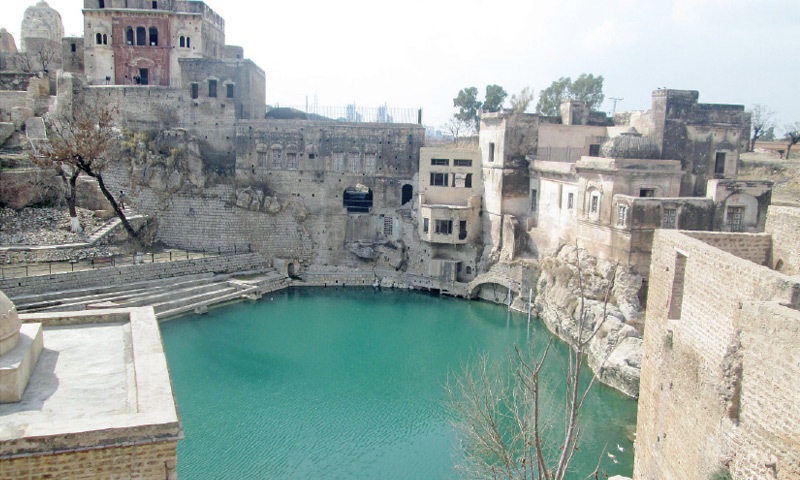
Alexander Cunningham, an engineer of the East India Company, dedicated much of his time to excavating and subsequently discovering many archaeological sites key to unearthing the history of the kingdoms of the past. Benefitting from the precision of Xuanzang, Cunningham was able to estimate the location of the long-lost city of Simhapura. He writes, ‘The vicinity of ten pools of water with surrounding temples points towards the holy tanks of Ketas, which are still visited by crowds of pilgrims from all parts of India.’ Unfortunately, although he was unable to properly excavate in Katas Raj, scholars unanimously agreed that Simhapura’s existence could be delimited to a triangular piece of land in the Chakwal district of Punjab.
Modern Discoveries
The 20th century was a golden period of archaeological discoveries, unearthing much of the cities of the Indus Civilisation, dating as far back as the Bronze Age. Miraculously, in 2018, archaeologists began a survey of the area by taking help from the accounts of Xuanzang and Cunningham. Their research led them to the shrine of Sheranwali Sarkaar.
The name of the shrine includes a reference to lions, like the word ‘simha’ in Simhapura. Linguistic similarities aside, the critical connection was established due to the fact that the site is north of Katas Raj and northwest of Murti, which aligned exactly with the coordinates left behind by Xuanzang. Presently, it seems that little work has been done to carry out proper excavations since the publication of these findings.
In the grand scheme of things, explorers in every epoch have made their effort to unearth the rich history of this region bit by bit, and there is still a long way to go if we want to bring the history of our great nation to the forefront rather than letting it hover on the peripheries of the bigger picture.
Superb ma Sha Allah
it kept me going without getting bored