





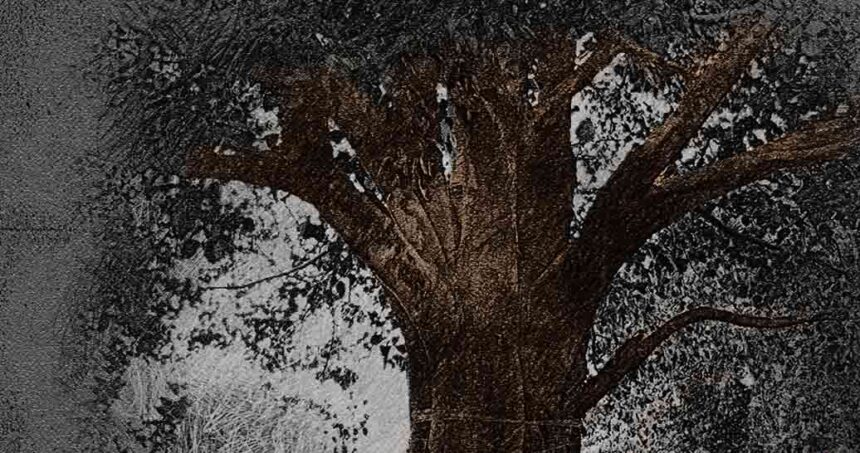
Horror in South Asia is not invented so much as inherited. Seldom questioned, it settles into our domestic and social spaces. Bequeathed to us in the rafters of our ancestral homes, into the cadence of our proverbs, in the oxidised, red dust of an unopened iron dowry trunk, and sometimes slipping into the subtle tonal shifts of a grandmother’s voice when candles flicker during a load-shedding-stricken evening. It appears, too, in the protruding, almost human fingers of a solemn peepal tree standing watch at the edge of a sleeping mohalla. What circulates here is neither pristine imagination nor simple superstition but a history rooted in gritty realities, carried, repeated, and reworked across generations.
In South Asia, the image of the restless female dead stands as one of the most enduring constructions that manifest this continuity. She appears with striking regularity across regions and languages, but not arbitrarily. Emerging at the precise point where social systems, kinship, ritual, caste, and economy fail to contain or protect the female body. Moreover, she is used in the oral tradition as a witness to suffering and also as a tool of vengeance, hewn in human flesh and shadow.
The churel, widespread across North India and Punjabi folklore, is one of the most widespread articulations of this pattern. Often flattened in popular Anglophonic retellings into a generic ghost woman, she is actually the ghost of a woman who perishes in the biological and social crucible of pregnancy or childbirth. Early ethnographers, including William Crooke in his An Introduction to the Popular Religion and Folklore of Northern India (1894), observed that in the late nineteenth century, churels were supposed to come back to the target men (especially when they did not receive proper funerary rites or when the death of a woman was surrounded by cruelty or indifference).
Her appearance is deliberately unsettling. She is marked by distortion: her feet are backwards twisted, her hair unbound and matted, and her face is alternately radiant and cadaverous. She comes to men plying lonely rural roads, entices them with her beauty, and then sucks away their vitality in vengeance against their collective male inhumanity. These features function as narrative markers, encoding the conditions of her death and the rupture it represents. The reproductive body, once disciplined and contained, returns altered and excessive. In some urban legends, she wears an almost blood-stained, red-and-white sari of a married woman; in others, she appears unclothed. In all of these cases, her form signifies a disruption of normative femininity, rendering visible the fraught social conditions that produced her.
Further east, the Petni, or the literally translated hungry woman, appears as a different configuration of unrest, especially in Bengal. Her stories are directly related to the Bengal Famine of 1943, where starvation unfolded on a scale that exceeded documentation. While the Churel seeks vengeance, the Petni hankers after satiety. Historical accounts of the famine indicate that women were among those most disproportionately affected. In many South Asian households, women eat last — a practice that becomes most consequential when food is scarce, effectively turning cultural order into a mechanism of deprivation. She is situated in paddy fields, near ponds, at particular hours of the day. Her hunger is tied to these locations, giving famine a spatial afterlife. The stories do not catalogue the event of famine so much as retain its texture — its persistence and its inability to conclude.
The Yakshi — especially figures such as Kalliyankattu Neeli — emerges from a historically and socially specific context in Kerala’s folklore tradition, particularly as preserved in texts like Aithihyamala and earlier oral ballads. At least in several canonical versions, Neeli is the daughter of a devadasi whose life is organised according to strict caste and ritual limitations. It is her association with a priest that is the subject of many deceitful acts, exploitation and eventual murder that causes her to transform into a Yakshi. It is also notable that the Yakshi stories, too, are highly localised in space. Such is the case of Neeli, who cannot be separated from Kalliyankadu, the forest where she was killed and haunts travellers to this day.
Across these horror figures, what becomes conspicuous is not only a shared gender-centric mythology but also a shared form of structural violence that the female gender endured. These stories preserve forms of violence that remain unevenly documented, often excluded from formal histories. This is achieved not merely by archival recording of events but also by attaching them to female bodies and tangible locations.
Perhaps the greatest merit of these stories is how they store and transmit information, but not in a stable or centralised form. They are activated through repetition, altered in each telling, and anchored to environments that retain their charge. What persists is not detail but the pattern, which is of a recurring alignment between gendered vulnerability and unfinished death.
The endurance of the restless female dead, then, is not simply a matter of the narrative appeal of the horror genre. It reflects the fact that the conditions producing these figures — maternal mortality, hunger, caste-bound exploitation — have not been fully resolved. The stories continue because the structures they register continue.
What returns in them is not the past as such but its refusal to remain past.