





Overview
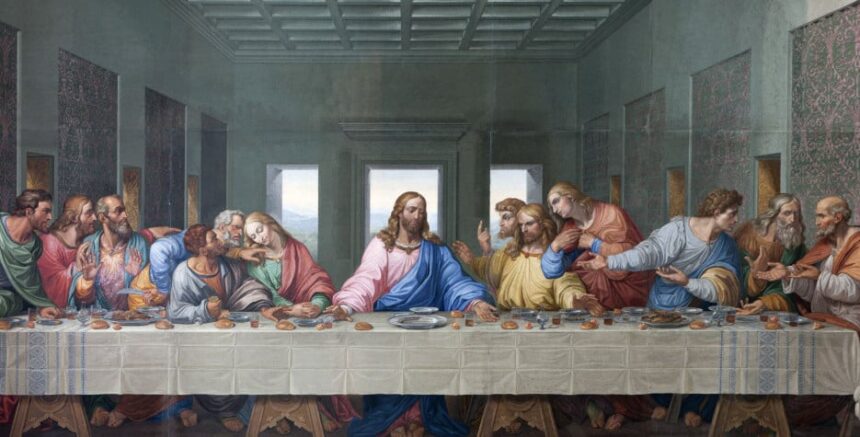
Maundy Thursday, also called Holy Thursday, commemorates the Last Supper of Jesus Christ. It is a significant celebration for Christians, marking the occasion when Jesus instituted the Holy Eucharist. It also marks the beginning of the Easter Triduum, honouring the institution of the priesthood, the washing of the disciples’ feet, and the arrest of Jesus in the Garden of Gethsemane. The word “Maundy” comes from the Latin mandatum, meaning “command,” referencing Jesus’ command: “Love one another as I have loved you” (John 13:34–35) — “By this all men know that you are my disciples.”
At the Last Supper, Jesus shared a final Passover meal with his disciples, breaking bread and wine as his Holy Body and Blood.
The Washing of Feet
Jesus washed his disciples’ feet, demonstrating servant leadership and humility, preparing them for ministry and love for one another (John 13:4–14). During the meal with his disciples:
- V4: He got up from the meal, took off his outer clothing, and wrapped a towel around his waist.
- V5: After that, he poured water into a basin and began to wash his disciples’ feet, drying them with the towel that was wrapped around him.
- V6: He came to Simon Peter, who said to him, “Lord, are you going to wash my feet?”
- V7: Jesus replied, “You do not realise now what I am doing, but later you will understand.”
- V8: “No,” said Peter, “you shall never wash my feet.” Jesus answered, “Unless I wash you, you have no part with me.”
- V9: Then Simon Peter replied, “Lord, not just my feet but my hands and my head as well.”
- V10: Jesus answered, “Those who have had a bath need only to wash their feet; their whole body is clean, and you are clean, though not every one of you.”
- V11: For he knew who was going to betray him, and that was why he said not everyone was clean.
- V12: When he had finished washing their feet, he put on his clothes and returned to his place. “Do you understand what I have done for you?” he asked them.
V13: “You call me Teacher and Lord, and rightly so, for that is what I am.”
- V14: “Now that I, your Lord and Teacher, have washed your feet, you also should wash one another’s feet.”
Jesus, in John 13, demonstrates that washing feet is centred on humanity, servant leadership, and spiritual cleansing. As their Teacher, he showed by example that his followers should do the same. By this act, Jesus Christ taught us to be humble and to serve even the least among us. When Peter said that Jesus would never wash his feet, he could not believe that the Son of God — the Messiah and his Teacher — would perform such a lowly task, as washing feet was work typically given to a servant. Jesus showed that true love means serving one another at the lowest level. He said to Peter: “If you cannot learn from me, then you have no share in me.” Peter then asked Jesus to wash him. Jesus told him that he was already spiritually clean; he only needed to learn from Jesus to become a humble servant of his brothers and followers.
Institution of the Eucharist
Christians celebrate Maundy Thursday as the day of the feast, because Jesus gave us food to nourish our souls until he comes again. Christians also hold that the Holy Mass and Communion began on this day.
When Jesus was having a meal with his disciples, he broke bread and shared grape juice (grape juice that is preserved and drunk out of season is called wine; good wine contains alcohol consistent with the fermentation of grapes; when grape juice is further fermented, it becomes brandy; people have long drunk these as beverages during meals). During the Passover, grape juice was used as a beverage with the meal. While establishing the new covenant, Jesus identified the bread and said, “Eat this — it is my Body, which will be sacrificed for your sins.” He then took the cup of grape juice and said, “Drink from this cup, because it is my Blood, which will be shed for you,” commanding his followers to do this in remembrance of him (Luke 22:14–20; Matthew 26:26–30; Mark 14:22–26; 1 Corinthians 11:23–25).
Agony in the Garden
Following the supper, Jesus went to Gethsemane to pray, where he was betrayed by Judas and arrested.
Jesus knew that the time of his Passion had arrived. He went to the Brook Kidron (also called Kedron) to pray (John 18:1). The Kidron runs through a deep valley between the Mount of Olives and the city of Jerusalem. Jesus often went there with his disciples, and
Judas Iscariot knew the place well. Jesus wanted to stay awake and pray. He took Peter, James, and John a little distance from the others, asking them to keep watch and pray. He went further ahead to pray alone and returned to his disciples twice, finding them asleep both times. The third time, he said: “Keep sleeping now, because the spirit is willing but the body is weak.”
- John 18:3: Judas, having gathered a band of soldiers and officers from the chief priests and Pharisees, came to the garden with lanterns, torches, and weapons. It was a full moon, but treachery and hatred distrusted its gentle light, so the enemies brought their own.
- V4: Jesus, knowing all that was to come, went forward and asked, “Whom do you seek?”
- V5: “Jesus of Nazareth,” they replied.
- V6: When Jesus said, “I am he,” they drew back and fell to the ground.
- V7: Jesus asked again, “Who is it you want?”
- V8: “Jesus of Nazareth,” they said. Jesus answered, “I told you that I am he. If you are looking for me, then let these men go.”
- V9: This happened to fulfil the words Jesus had spoken (John 17:12): “Those whom you gave me I have kept, and none of them is lost but the son of perdition” — referring to Judas, who sinned wilfully — fulfilling Psalm 41:9; 69:25–29; 109:8; and Acts 1:20–25.
- V10: Then Simon Peter, who had a sword, drew it and struck the high priest’s servant, Malchus, cutting off his right ear.
- V11: Jesus commanded Peter, “Put your sword away. Shall I not drink the cup the
Father has given me?”
- V12: The detachment of soldiers with its commander and the Jewish officials then arrested Jesus and bound him.
- V13: They brought him first to Annas, who was the father-in-law of Caiaphas, the high priest that year.
- V14: Caiaphas was the one who had advised the Jewish leaders that it would be good for one man to die for the people.
Peter’s Denial
- V15: Simon Peter and another disciple followed Jesus. Because this disciple was known to the high priest, he entered the high priest’s courtyard with Jesus.
- V16: Peter had to wait outside at the door. The other disciple, known to the high priest, came back, spoke to the servant girl on duty, and brought Peter in.
- V17: “You are not one of this man’s disciples too, are you?” she asked Peter. He replied, “I am not.”
V18: It was cold, and the servants and officials stood around a fire they had made to keep warm. Peter also stood with them, warming himself.
Jesus Before the High Priest
- V19: Meanwhile, the high priest questioned Jesus about his disciples and his teachings.
- V20: “I have spoken openly to the world,” Jesus replied. “I always taught in synagogues or at the temple, where all the Jews come together. I said nothing in secret.”
- V21: “Why question me? Ask those who heard me. Surely they know what I said.”
- V22: When Jesus said this, one of the officials nearby slapped him in the face. “Is this the way you answer the high priest?” he demanded.
- V23: “If I said something wrong,” Jesus replied, “testify as to what is wrong. But if I spoke the truth, why did you strike me?”
- V24: Annas then sent him to Caiaphas the high priest.
Peter’s Second and Third Denial:
- V25: Meanwhile, Simon Peter was still standing there warming himself. They asked him, “You are not one of his disciples too, are you?” He denied it, saying, “I am not.”
- V26: One of the high priest’s servants, a relative of the man whose ear Peter had cut off, challenged him: “Didn’t I see you with him in the garden?”
- V27: Again Peter denied it, and at that moment a rooster began to crow.
The Gospel of Mark tells us that the young man following Jesus was Mark himself, who had a contact in the high priest’s house. Mark 14:51 records: “A certain young man, having a linen cloth cast about him, was following; and they laid hold on him, but he left the linen cloth and fled from them naked.” Mark was thus an eyewitness inside the hall where the Sanhedrin was questioning Jesus. Mark 14:55 records: “The chief priests and all the Council sought witnesses against Jesus to put him to death, and found none.” Mark 14:56:
“For many bore false witness against him, but their testimony did not agree.” Mark 14:57–59: Two men made false accusations, claiming Jesus said he would destroy the temple and rebuild it in three days, but even their testimonies did not agree. Mark 14:60–61: The high priest stood up and asked Jesus, “Do you not answer? What is it which these testify against you?” But Jesus kept his peace, for he knew they did not want to hear the truth. Mark 14:62: The high priest then asked, “Are you the Christ, the Son of the Blessed?” Jesus answered boldly, “I am” — and added that all would see the Son of Man sitting at the right hand of Power and coming in the clouds of heaven, referring to the Great Throne of Judgement and his Second Coming. Mark 14:63–64: The high priest tore his clothes, declaring blasphemy, and the Council condemned Jesus to death. Mark 15:1:
Early the next morning, the chief priests, elders, scribes, and the whole council bound Jesus and handed him over to Pilate, the Roman governor of Jerusalem.
The Arrest of Our Lord Jesus Christ
This event is recorded in Matthew 26, Mark 14, Luke 22, and John 18.
Jesus was arrested in the Garden of Gethsemane. While he was speaking with his disciples, a large armed crowd — sent by the chief priests and elders and led by Judas Iscariot — arrived at the garden. Judas identified Jesus with a kiss. Jesus then voluntarily surrendered, preventing his disciples from further resistance, despite the crowd’s hostile arrival in the night. The crowd consisted of temple police, temple guards, and possibly Roman soldiers, all arriving with torches and lanterns. Jesus identified himself by saying “I am he,” at which the soldiers drew back and fell to the ground. Peter drew a sword and cut off the ear of Malchus, the high priest’s servant, but Jesus commanded him to stop and healed the servant’s ear before surrendering.
Following the arrest, the disciples fled, and Jesus was taken to Annas to be charged. The authorities tried throughout the night to bring a credible accusation against him but could not. Finally, they settled on two charges: preventing people from paying taxes to Caesar, and blasphemy. Because the Jewish Sanhedrin was restricted by Roman law from carrying out a death sentence, they handed Jesus over to the Roman governor Pilate.
Jesus Before Pilate
(At the dawn of Good Friday)
John 18:28: The Jewish leaders took Jesus from Caiaphas to the palace of the Roman governor. By now it was early morning. To avoid ceremonial uncleanness, they did not enter the palace, as Jews considered entering a Gentile’s dwelling spiritually defiling; they also wanted to remain clean so they could eat the Passover.
- V29: Pilate came out to them and asked, “What charges are you bringing against this man?”
- V30: “If he were not a criminal,” they replied, “we would not have handed him over to you.”
- V31: Pilate said, “Take him yourselves and judge him by your own law.” “But we have no right to execute anyone,” they objected.
- V32: This took place to fulfil what Jesus had said about the kind of death he was going to die.
- V33: Pilate went back inside the palace, summoned Jesus, and asked him, “Are you the king of the Jews?”
- V34: “Is that your own idea,” Jesus asked, “or did others talk to you about me?”
V35: “Am I a Jew?” Pilate replied. “Your own people and chief priests handed you over to me. What is it you have done?”
- V36: Jesus said, “My kingdom is not of this world. If it were, my servants would fight to prevent my arrest by the Jewish leaders. But my kingdom is from another place.”
- V37: “You are a king, then?” said Pilate. Jesus answered, “You say that I am a king. In fact, the reason I was born and came into the world was to testify to the truth. Everyone on the side of truth listens to me.”
Liturgical Celebrations
During the worship service on Maundy Thursday, the following are observed:
- Ceremonial washing of feet, as a re-enactment of the Lord’s Last Supper.
- Stripping of the altar: During the service, the church altar is stripped bare, symbolising Jesus being stripped of his dignity and the impending desolation of Good Friday.
- Silent watch: A period of silence is observed for adoration in a Garden of Repose; a Holy Hour of prayer with the Lord is also held.
What Christians Do Not Do
During Maundy Thursday and Good Friday, worship services are not announced by ringing bells. It is considered inappropriate to bathe, make noise, laugh or smile, or engage in comedy or entertainment on these days. On Good Friday — especially at 3:00 p.m. — such activities are particularly taboo. Roasting food during Holy Week is also considered contrary to the spirit of the observance.
A Call to Learn from Jesus’ Passion
In the Garden of Gethsemane, Jesus went with his disciples to pray, as was his custom
(Matthew 26:40–41). He was in deep agony and wanted to stay awake in prayer. He took Peter, James, and John a few steps further than the others, asking them to keep watch and pray. He returned to them three times and found them sleeping on each occasion. Jesus said: “Could you not watch with me even one hour? Keep watch and pray, so that you will not give in to temptation — for the spirit is willing but the body is weak.”
Jesus was fully aware of his disciples’ human limitations and was preparing them for the temptation of abandoning him during his trial. His words call us to examine every aspect of our lives through the lens of Jesus Christ. Not one thought, not one circumstance, not one interaction should fall outside the holy standard he set. The moment we approach a situation apart from that standard, we open ourselves to temptation. As St Paul assures us (1 Corinthians 10:13): “The temptations in your life are no different from what others experience. And God is faithful; he will not allow the temptation to be more than you can stand. When you are tempted, he will show you a way out so that you can endure.”
There is no purpose in celebrating these holy occasions if we do not learn from them and allow them to transform us. Jesus, thank you for your never-ending grace.