





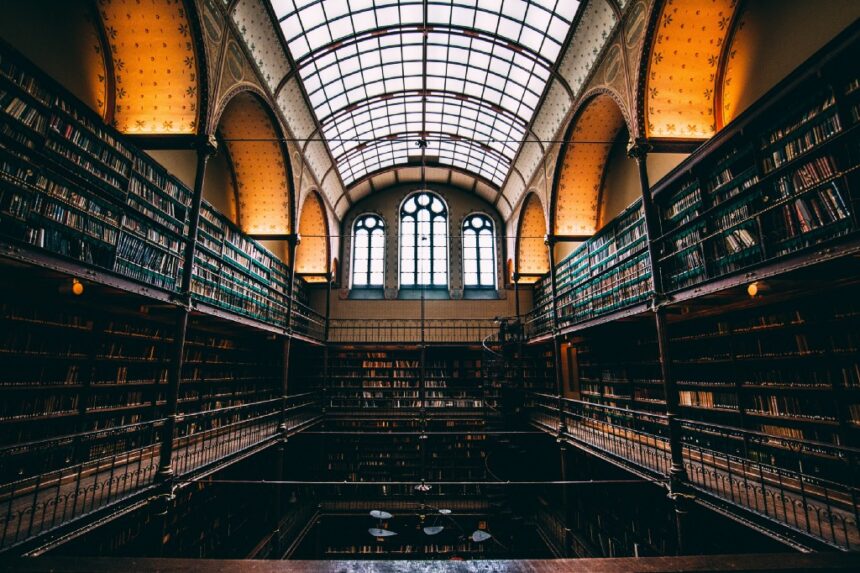
The smell of old, yellowing paper as I turn a page over; the soft rustling of pages when they rub against each other; the sure heaviness of the book as it lies open in my hands, revealing ink and print that takes me to a whole other world unknown and lets me glimpse inside the minds of people I have never met, fleetingly as it may be. I have held books as such, using them as a barrier against the world, hiding in the crevices of the pages or in the curves of the letters because no place felt safer or more enchanting than the layers of sentences that draped on me like warm blankets.
Books have long been used to escape from the savagery of the real world. Libraries have been around for over 5,000 years, originating in Mesopotamia as archives of clay tablets, and we have had many noteworthy libraries of publications since, like the libraries in Alexandria and Rome. Reports also indicate the existence of stalls in ancient Greece and Rome that sold scrolls and manuscripts, which we can assume were the initial steps towards the establishment of modern bookshops.
Libraries and bookshops have long held the fort of ideas and knowledge, being hubs of adventure, magic and a million journeys. Lately, however, there has been a shift in how books are consumed. E-books, algorithms and audiobooks have burst onto the scene and taken centre stage. Convenience and personally tailored lists have turned people towards electronic media, streaming subscriptions and Kindle Unlimited. Why make the trek to a library when one has access to all bookish content on screens?
Libraries are, thus, being underused and underfunded. Independent bookshops struggle to stay afloat. What starts as a passion project ultimately succumbs to the human need for having food on the table. Love is made the sacrificial lamb at the mercy of necessity.
I remember when I was around 7 years old, and my mother had taken me to a library for the first time. The memory feels surreal, like a fever dream, and I wouldn’t be surprised if there was magic involved. The huge brown door had opened, and lying in front of me was an expanse of marble floors and wall-to-wall bookshelves. Walls that didn’t have bookshelves had floor-to-ceiling windows which let in glittery sunshine, giving the entire room a mystical glow. I, enraptured by the scene, belatedly realised the elderly librarian was talking to me. “First time here?” His soft chuckle had rung in my ears, and I was convinced he was an elf or some other magical creature of some sort. I was a child and wasn’t allowed a membership card of my own, but the librarian had promised me, “When you grow older, come back here, and I will make a library card for you myself.” It felt like one of those bargains with faeries you always read about in books. That day, I learned where books lived and how magic always surrounded them.
It was a formative experience of my life, but it really makes me wonder if this is the type of magic that the kids today are robbed of. Sitting in front of a screen, unmoving and blue light burning into their retinas, kids and adults alike have forgotten about the mystery of browsing through bookshelves to find one that fills you with intrigue without an algorithm presenting you with a pre-made ‘you might like this’ list.
This is not intended to be a pessimistic view of progress. It cannot be denied that ebooks, audiobooks and all these easy-access tools have made knowledge more widespread. It is also helpful for people with disabilities: those with dyslexia, the visually challenged, and those physically disabled and thus unable to visit libraries or book stores on a regular basis. Students can easily access expensive books online. Citizens of countries and places that don’t have the privilege of public libraries can obtain these streaming services, too. Digitalising books has certainly helped education, knowledge and entertainment become more accessible. And, while all that is true, I believe we can still mourn the silent death of libraries.
The place where like-minded people gathered to experience and share stories and to form bonds over mutual interests: Sunday book clubs, poetry readings, research groups and whatnot. It served as a way to keep the community alive and mould a sanctuary for those wishing to get lost in the pages. To let people jump down the rabbit holes, walk through magical wardrobes, or spearhead through a portal at platform 9¾. It reminds us that reading does not have to be a solitary activity; it allows us to meet amazing, imaginative and sometimes eccentric people. Such places and such people keep the magic alive, if I dare make such a whopping statement myself, because I believed in the magic when I was 7, and it had mercilessly lured me into the world of books and fairy tales. Something that I have never regretted once.
E-books, audiobooks, podcasts, and curated algorithms are fine in and of themselves; they are helpful and accommodating and will probably evolve to become more so, but I truly hope they don’t dull the glamour that is in the old bookshop around the corner, doused in candlelight and the smell of yellowing pages and spilt ink, with perhaps little elves hiding in corners that come out periodically to dust and shelve the books.
A touching reflection on how the magic of libraries is slowly slipping away.