





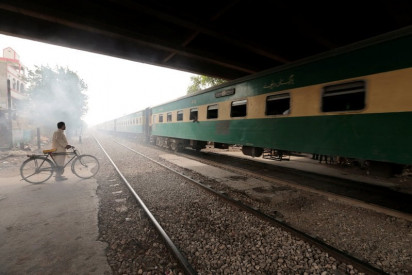
“The train never came. But waiting never stopped.”
A porter at Karachi City Station overheard in 2019.
There is a particular kind of grief that has no funeral, no eulogy, and no stone carved with dates. It’s the grief of the thing that almost was. Like the road that was promised, the school that was announced, and the train that was inaugurated and then, quietly, never came. Pakistan has accumulated this grief in abundance, and nowhere more visibly than in its railways. To travel through Pakistan’s railway history is not merely to catalogue failure. It’s to understand a particular psychology of governance, one in which announcement is mistaken for action. It is, more poignantly, to sit with the communities who organised their lives around a promise, who built tea stalls near a station that was never opened, and who waited for a train that became a metaphor before it ever became a train.
What does it mean to wait for something that was never truly intended to arrive?
The question is not simply political, although politics is everywhere in this story. It asks us to consider what infrastructure truly is: not steel and concrete, not budgets and tenders, but a covenant between the state and the people who claim to serve the state. Which, upon being broken as it has been repeatedly across Pakistan’s railway map, what remains is not merely inconvenience. What remains is a quiet confirmation that certain lives are considered less worthy of arrival.
- The Karachi Circular Railway
Once, Karachi moved. Not with the halt-to-go of its contemporary traffic, but with the Karachi Circular Railway, the KCR. Between 1964 and its collapse into irrelevance by the early 1990s, KCR carried as many as 100,000 passengers a day across 43 kilometres. It was imperfect and often overcrowded, but it was real. It moved people from Orangi, Landhi, and Malir into the commercial and industrial sectors of the city, which was, for that brief period of time, the hub of Pakistan’s economics.
Then it stopped altogether.
Not abruptly; rather, the change was gradual. At first, the services were reduced, then the trains ran less frequently. The tracks were encroached upon. Katchi abadis grew in the right of way. Vendors set up stalls. Children played on the rails.
Every few years, sometimes tied to election cycles, sometimes to international development pledges, sometimes to the fever of CPEC, the KCR would be revived. Announcements were made. Committees were formed. Foreign legislation was visited. Numbers were cited: millions of rupees, thousands of daily commenters, emissions reduced, and traffic decongested. And then, with the changing season, the announcements would recede just like they did before.
Between 1999 and 2023, the KCR was officially revived no fewer than seven times. Seven revivals. Seven disappointments. And the people of Orangi Town still wake before dawn to catch buses that will take 2 hours to travel 12 kilometres.
- The Khyber Railway
There are railways whose abandonment is merely logistical; it’s a matter of economics, of shifting population. And then there is the Khyber Railway, whose abandonment feels closer to cultural decay.
The Khyber Railway was constructed between 1925 and 1926 by the British. The narrow line from Jamrud to Landi Kotal climbed 914 metres over 42 kilometres through Khyber Pass. To build it, engineers designed 34 tunnels and 92 bridges. It was militarily and commercially important for a time. It connected the subcontinent to Afghanistan at a point where conquerors and traders had passed for millennia. It was the area where Alexander’s armies had marched, where Babar had descended, and where the British had bled across three wars. The railway had a history of ages, yet regular service ended in 1982. The official reasons were mundane: high operating costs, low passenger numbers, and security concerns. But the line wasn’t formally decommissioned. Special tourist trains ran occasionally. A revival was discussed, but it never happened.
The Khyber Pass has watched armies, poets, and prophets. That the railway through it couldn’t survive bureaucratic neglect tells us something melancholic about what we have chosen to preserve.
There is a line of inquiry that Pakistan’s ghost railways make unavoidable. Why does Karachi, a city overwhelmingly populated by working-class migrants from all over the country, have the KCR promise dangled before it while the vehicles of the wealthy glide on roads built with the same public funds? Why did the Khyber Railway serve Pashtun communities for 60 years before being abandoned without any replacement?
Pakistan’s railways don’t fail dramatically. They fail through repetition and through the slow accumulation of promises not kept until the very word “soon” begins to sound like a form of refusal.