





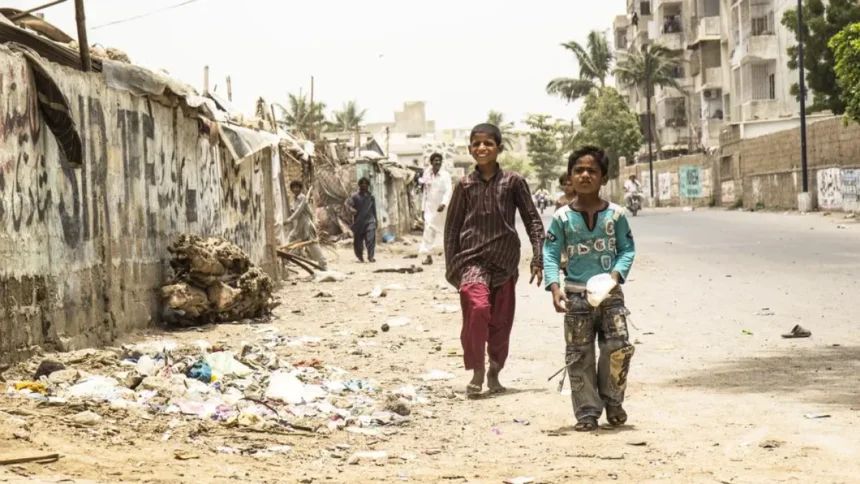
As a child, whenever our car stopped at a traffic signal on the way to school, there would be a knock on the window. We were told to ignore it, to pretend it did not exist, but the knocking would persist. More often than we would admit, the hand against the glass belonged to a child my age, separated from me by a pane of glass, in a ragged state. Two parallels of reality. Two reflections of the same society, gazing into each other’s eyes.
I would often wonder, why do these children choose this life? Why do they not study like me instead? The thoughts and questions would linger for a while, and then the signal would turn green, and the beggar child would remain behind — forgotten — while I was driven forward.
It was only later that I realised that being a “child of the street” was never a choice. It was a compulsion, a mark of destiny that these children never chose to set upon, borne out of economic segregation, societal neglect, and the result of institutional failures.
In Pakistan, approximately 1.5 million either call the street their home or are forced into street-based labour to earn a livelihood. It is on these very streets, bereft of shelter and the warmth of a caring parent, that these children fall prey to violence, exploitation, and most tragically, substance indulgence.
A study conducted in Islamabad in 2022 indicated that more than half of surveyed street children were involved in substance use. Approximately 62.5% were initially exposed to cigarette smoking before progressing to more harmful narcotics. The study further revealed that one-third of them (37%) were using substances such as heroin, hashish, and bhang.
For many of these children, drugs serve as a coping mechanism, dulling hunger, numbing emotional trauma, and offering a means of temporary escape from the harshness of street life.
Others are introduced to drugs through family exposure, friends’ peer pressure or local drug networks, where substance use becomes normalised. Intoxication, in an environment where everyday survival is a challenge, becomes both a refuge and a trap.
The health implications of intoxication by drugs are profound. Studies show that substance abuse during adolescence disrupts brain development and impairs neural pathways linked with cognition. It also increases the risk of long-term dependency. Moreover, addiction may also lead to increased risk-taking behaviour, such as indulgence in criminal activities, violence, delinquency, and, in severe cases, suicidal tendencies. Impaired judgement due to addiction renders these children vulnerable to exploitation by drug traffickers, organised begging mafias, and sex trafficking networks, often in exchange for substances. The risks are not merely health-limited; they represent the loss of 1.5 million potentials and unrealised futures: children who could be contributors to society, innovators, students, and leaders instead of victims of systemic neglect.
Perhaps most troubling is not only addiction itself but also our collective response to it. The disapproval, even disgust, with which we often recoil when a ragged child approaches our window, the way we roll up our windows, is a reflection of a deep-rooted societal mindset to alienate and invisibilise the vulnerable. By looking away, we simply convince ourselves that the problem doesn’t exist. Yet the window does not indefinitely separate the two worlds; it reflects the cracks within the same one.
Existing child protection frameworks in Pakistan remain inadequately enforced. Rehabilitation set-ups are under-resourced and frequently inaccessible, with mostly NGOs and not-for-profit rehabilitative initiatives striving to facilitate the children and their families. However, their reach remains limited and fragmented, leaving a significant proportion of children underserved. The resolution of the fate of 1.5 million children requires prioritising this issue and fostering collaboration between government institutions, civil society, and non-governmental organisations with a comprehensive approach and adequate resource allocation.
The approach may involve setting up rehabilitation programmes that extend beyond temporary shelter for the children to structured addiction treatment, psychological counselling, and long-term reintegration. Welfare initiatives along with vocational education should be drafted to provide children from impoverished backgrounds the opportunity to both study and earn with dignity. But most of all, change shall also have to begin with an evolution in our individual attitudes and thoughts. It should involve teaching our younger generation to not see or perceive them as a secluded segment of society or outcasts but as equal humans worthy of respect who are trapped by the predicament of fate and devoid of access to equal opportunities.
The next time a knock echoes against a car window, it should not serve as a cue for indifference or disgust but as a reminder of our responsibility to the children of the streets. It should remind us that the futures behind that glass are not quite separate from our own and deserve not to be forgotten but to be given a second chance.