





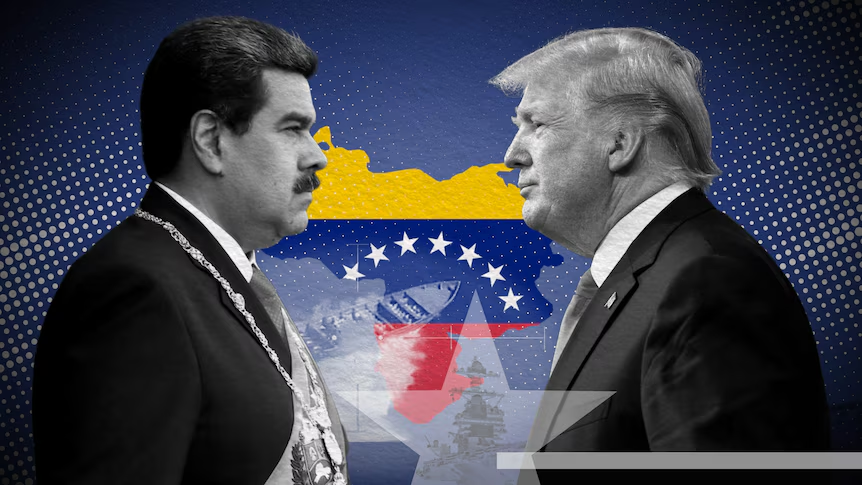
Venezuela has been a paradise in the political community because it is a country with the largest oil reservoir in the world, yet it has always been in the grip of political seclusion, economic downfall, and foreign influence. With Donald Trump’s new impact on international policy, Venezuela has again become the subject of American strategic interest. The difference between the Trump-era action and previous US pressure campaigns lies not only in intensity but also in the direction of the campaigns; however, instead of regime change rhetoric, it is more focused on structural control of the market, resources, and rule.
The paper posits that US policy toward Venezuela under Trump is a kind of economic monopolisation implemented by means of coercive sanctions, the naval blockade, and partiality in accessing oil markets. More to the point, it argues that these actions are silently altering the boundaries of international law in 2026 and establishing a precedent that could easily lead to the normalisation of unilateral blockades and control over resources by strong states.
Dominance Through Economic Pressure
The US policy towards Venezuela has had sanctions that have historically been used, but Trump rebranded them as a punitive tool and turned them into a strategic tool. This attack on the state of Venezuela’s oil corporation, PDVSA, as well as third-party purchasers, effectively turned oil into a political poison in Venezuela. It was tariffed, or even the recipient countries were penalised, or diplomatic retaliation was taken.
This type of action is not a conventional economic pressure that aims at forcing policy change. The intention to render Venezuela out of independent participation in the world energy markets is what it means to be economically isolated. Only conditions accepted or monitored by Washington could transport oil, Venezuela’s lifeline. Once the US authorities publicly talked about the shift to American markets for Venezuelan oil flows, where incomes are controlled by outside forces, the logic behind it was revealed in a very transparent way.
This type of control can be compared with monopolistic behaviour in private market areas, where access is not limited by competition but rather by control. Here, domination is not by a corporation but by state force, supported by military presence and financial influence.
International Energy Markets and Strategic Expertise
This is a strategy that has global implications that are far beyond Venezuela. The insensitivity of energy markets to disruptions in supply and Venezuelan crude, especially heavy crude, has a specialised role in refining chains. The US also benefits economically as well as having geopolitical power by diverting the Venezuelan oil to the US refiners and away from its competitors like China.
China and other nations that used to depend on Colombian energy have been compelled to find alternatives at a relatively expensive cost or through politically unstable suppliers. In the meantime, the US gains ground as a controller and consumer of energy flows. This dualism of participation and control confuses the participation and control of the market.
The threat is not only imbalance but also normalisation.
When the global energy market acknowledges that a large state can unilaterally decide who can sell and who can buy and do so without any multilateral agreement, the concepts of free trade and sovereign equality become merely symbolic.
The Legal Issue of the Blockade
The naval blockade and interdiction of the oil shipments can be perhaps the most consequential in Trump-era policy. International law typically associates blockades with armed conflict and requires legal justification. The Charter of the United Nations forbids the incorporation of force in a sovereign state unless it is in self-defence or when approved by the Security Council.
In Venezuela’s case, neither of the conditions is evident. The UN’s non-cooperation has been disapproved, and Venezuela has not yet begun an armed attack to justify self-defence. The blockade has instead been promoted as the imposition of sanctions and defence of international security interests. The framing is weak in the legal sense.
Unilateral sanctions do not necessarily confer physical interception of the commercial vessels. The imposition of economic restrictions through the use of naval force during peacetime becomes more of a grey area. The United States is not only exerting pressure on Venezuela by asserting the right to unilaterally block the shipment of oil, but it is also coyly probing the boundaries of what is acceptable behaviour of states under international law.
A Precedent in the Making (2026)
The true value of the Venezuelan case is not so much in what happened but in what may emerge as ordinary. Provided that such blockades are not challenged, they stand a chance of becoming precedents. The rest of the powerful states can use the same tactics in their defence in the name of national security or economic stability.
In 2026, international law is poised at a crucial juncture. The lack of action by the institutions, such as the International Court of Justice, the UN General Assembly or the regional entities, may represent implicit consent. Gradually, customary international law is developed not only by treaties but also by repeated custom.
It normalises a world where sovereignty over natural resources is conditional, market entry is influenced by geopolitical conformity, and economic coercion is supported by force, viewed as a normal policy consideration rather than an exception.
Conclusion
The Trump policy towards Venezuela involves not only sanctions and oil but also power without mediation. By means of economic coercion, market exclusion and naval enforcement, the United States has proceeded to monopolise possession of a strategic resource and has also been broadening the borders of international legality.