





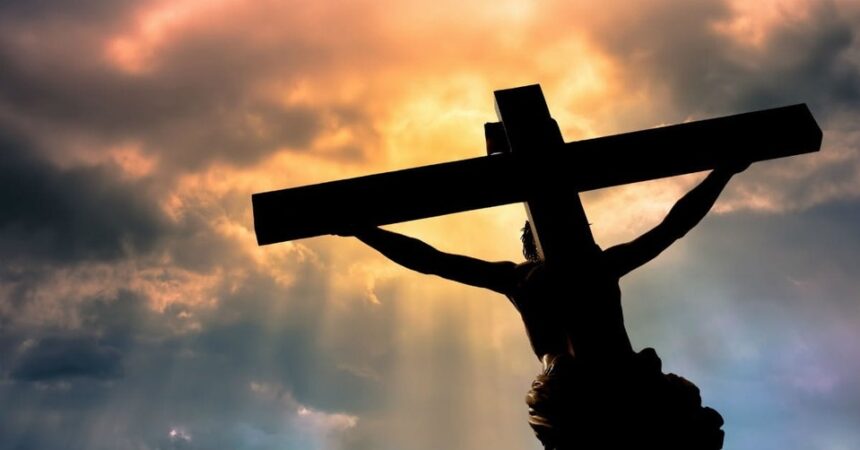
Why are the streets of Jerusalem filled with people on Good Friday? Because Jesus is dragging His cross, bearing the sin committed by our first parents, Adam and Eve, to offer His own sacrifice at Golgotha and bring us atonement and redemption.
Jesus before Pilate
The Jewish leaders took Jesus from Caiaphas to the palace of the Roman governor, Pilate, early in the morning. To avoid ceremonial uncleanness and to be able to eat the Passover, they refused to enter the palace, so Pilate came out to them and asked, “What charges are you bringing against this man?” (John 18:28–29). They replied, “If he were not a criminal, we would not have handed him over to you” (John 18:30).
Pilate said, “Take him yourselves and judge him by your own law,” but they answered, “We have no right to execute anyone.” This happened so that the words Jesus had spoken about the kind of death he was going to die would be fulfilled (John 18:31–32). Pilate then went back inside the palace, summoned Jesus, and asked him, “Are you the king of the Jews?” (John 18:33).
Jesus answered, “Is that your own idea, or did others talk to you about me?” Pilate replied, “Am I a Jew? Your own people and chief priests handed you over to me. What is it you have done?” (John 18:34–35). Jesus said, “My kingdom is not of this world. If it were, my servants would fight to prevent my arrest by the Jewish leaders. But now my kingdom is from another place” (John 18:36). “You are a king, then!” said Pilate. Jesus answered, “You say that I am a king. In fact, the reason I was born and came into the world is to testify to the truth. Everyone on the side of truth listens to me” (John 18:37). “What is truth?” retorted Pilate (John 18:38).
After this, Pilate went out again to the Jews and said, “I find no basis for a charge against him.” But it was the custom at the Passover to release one prisoner, so he asked, “Do you want me to release ‘the king of the Jews’?” They shouted back, “No, not him! Give us Barabbas!” Barabbas had taken part in an uprising (John 18:39–40).
Then Pilate took Jesus and had him scourged (John 19:1). The soldiers twisted together a crown of thorns and put it on his head, clothed him in a purple robe, and kept coming up to him, saying, “Hail, king of the Jews!” as they struck him in the face (John 19:2–3).
The Way of the Cross (Via Dolorosa)
Jesus is the most written-about person of the first century; millions of books in many languages describe His life, death, and resurrection. The Synoptic Gospels (Matthew, Mark, and Luke), together with the Gospel of John, are the primary sources that present His divinity, His relationship with God the Father, His ministry, His passion, and His resurrection. His mother tongue was Aramaic, and even the Gospel of Mark, written for a Greek audience, preserves several Aramaic expressions.
Historically, scholars have relied on the Gospels to resolve many questions about first-century Israel, its law, and its spiritual life. The Holy Bible is the key through which we understand the story that runs from Abraham and David to Jesus Christ, the only Son of the Holy God.
The fourteen traditional Stations of the Cross depict Jesus’ final journey to Calvary, beginning with His condemnation by Pilate and ending with His burial. These stations, especially during Lent, help believers spiritually accompany Jesus in His suffering, often through prayer and meditation on the passion narratives in Matthew 27, Mark 15, Luke 23, and John 19.
The Stations
1. Pilate condemns Jesus to die (Mark 15:6–15).
2. Jesus accepts His cross (John 19:15–17).
3. Jesus falls the first time.
4. Jesus meets His afflicted mother.
5. Simon of Cyrene helps Jesus carry the cross (Mark 15:21); he is the only man mentioned as helping Him, reminding us that we must carry the cross of our own sins.
6. Veronica offers her veil to Jesus.
7. Jesus falls the second time.
8. Jesus speaks to the women of Jerusalem (Luke 23:27–31).
9. Jesus falls the third time.
10. Jesus is stripped of His garments (Matthew 27:35; Luke 23:34).
11. Jesus is nailed to the cross (Luke 23:33–43).
12. Jesus dies upon the cross (Luke 23:44–46).
13. Jesus is taken down from the cross (John 19:38).
14. Jesus is placed in the tomb (John 19:42).
The Gospels do not explicitly record three falls, but it is reasonable to imagine that a man so badly tortured, forced to carry a heavy cross along an uneven path, would stumble more than once. It is also natural to think that His mother met Him on the way, as she was always close to Him, and that a courageous woman stepped out of the crowd to wipe the blood and sweat from His face.
The Crucifixion and Its Signs
The Temple authorities wanted the crucifixion completed before the start of Passover, so they pressed for a quick execution. Yet Scripture stresses that Jesus’ death was ultimately God’s plan, not simply a human plot; His death was part of the divine plan for the salvation of the world (John 3:16–17).
At the cross, Pilate placed the inscription, “This is Jesus, the King of the Jews” (Matthew 27:37). Two thieves were crucified with Him, one on His right and the other on His left, while passersby mocked Him and challenged Him to come down from the cross if He was truly the Son of God (Matthew 27:38–40). The chief priests, scribes, and elders mocked Him as well, saying, “He saved others; he cannot save himself. If he is the King of Israel, let him come down now from the cross, and we will believe in him” (Matthew 27:41–42).
From the sixth hour until the ninth hour darkness covered the land (Matthew 27:45). Then Jesus cried out with a loud voice, “Eli, Eli, lama sabachthani?”, which means, “My God, my God, why have you forsaken me?” (Matthew 27:46). One of them ran, took a sponge, filled it with vinegar, put it on a reed, and gave Him to drink (Matthew 27:48). Then Jesus cried again with a loud voice and yielded up His spirit (Matthew 27:50).
A Roman soldier pierced His side with a spear, and blood and water flowed out, confirming His physical death (John 19:34). Matthew records that at that moment the veil of the Temple was torn in two from top to bottom, the earth shook, rocks split, and tombs opened (Matthew 27:51–53). The centurion and those with him, seeing the earthquake and all that happened, were filled with fear and said, “Truly this was the Son of God” (Matthew 27:54).
Burial and the Guarded Tomb
Many women watched from a distance, including Mary Magdalene, Mary the mother of James and Joses, and the mother of the sons of Zebedee (Matthew 27:55–56). When evening came, Joseph of Arimathea, a rich man and disciple of Jesus, went to Pilate to ask for the body. Pilate granted his request, and Joseph wrapped the body in a clean linen cloth and laid it in his own new tomb, cut in the rock, then rolled a great stone in front of the entrance and departed (Matthew 27:57–60).
The chief priests and Pharisees then went to Pilate, recalling that Jesus had said while He was still alive, “After three days I will rise again.” They requested that the tomb be secured until the third day so that the disciples could not steal the body and tell the people, “He has risen from the dead” (Matthew 27:62–64). Pilate granted them a guard, and they sealed the stone and set a watch, so that both Roman authority and Temple leadership together confirmed that Jesus truly died and was buried (Matthew 27:65–66).
Good Friday is also known as Holy Friday, Great Friday, or the Friday of the Passion of the Lord. It is a solemn day during Holy Week, just before Easter, commemorating the suffering, crucifixion, and death of Jesus Christ at Calvary, usually observed by fasting, prayer, and meditation on the Stations of the Cross.
Atonement and God’s Plan
The Holy Bible presents Jesus’ arrest, trial, and crucifixion at Golgotha as a voluntary sacrifice for the sins of humanity, fulfilling many Old Testament prophecies. Atonement means reconciliation with God by removing the guilt of sin and restoring a broken relationship.
The New Testament teaches that Jesus died “once for all”; His sacrifice is sufficient, permanent, and does not need to be repeated. God sent His only begotten Son, conceived by the Holy Spirit in the womb of Mary, so that God the Son would take on true humanity and live among us.
For thirty-three years the Son lived in perfect obedience, and on the cross He shed His blood as the true and final sacrifice. Through that sacrifice, humanity received atonement and salvation.
Prophecies Fulfilled in the Passion
Many Old Testament prophecies point to the suffering and death of the Messiah. Some of the fulfillments mentioned in the article are listed below:
– Isaiah 53:3 — Rejected by His own people; fulfillment: John 1:11.
– Zechariah 9:9 — Triumphal entry; fulfillment: John 12:13–14.
– Psalm 41:9 — Betrayed by a friend; fulfillment: Mark 14:10.
– Zechariah 11:12 — Sold for thirty pieces of silver; fulfillment: Matthew 26:15.
– Zechariah 11:13 — Money returned; fulfillment: Matthew 27:6–7.
– Isaiah 53:7 — Silent when accused; fulfillment: Matthew 26:62–63.
– Isaiah 53:12 — Crucified with sinners; fulfillment: Matthew 27:38.
– Psalm 22:16 — Hands and feet pierced; fulfillment: John 20:27.
– Psalm 69:21 — Given gall and vinegar; fulfillment: John 19:29.
– Zechariah 12:10 — Side pierced; fulfillment: John 19:34.
– Isaiah 53:9 — Buried with the rich; fulfillment: Matthew 27:57–60.
– Psalm 16:10 — Resurrection; fulfillment: Matthew 28:9.
– Psalm 68:18 — Ascension; fulfillment: Luke 24:50–51.
These fulfilled prophecies show that the events of Good Friday were not random, but part of the plan foretold in Scripture.
The Seven Last Sayings from the Cross
On the cross, Jesus spoke seven final, meaningful sentences, preserved across the four Gospels. Christians often meditate on these sayings, especially in Lent and on Good Friday, to understand more deeply His forgiveness, love, and sacrifice.
- “Father, forgive them, for they know not what they do” (Luke 23:34)
As He was being crucified, Jesus prayed for those who were killing Him and for those who demanded His death. He acts as our advocate, asking the Father to forgive even those directly responsible for His crucifixion. This is the supreme example of radical forgiveness.
- “Truly, I say to you, today you will be with me in paradise” (Luke 23:43)
One of the criminals crucified beside Jesus turned to Him in faith and asked to be remembered in His kingdom. Jesus answered, “Today you will be with me in paradise,” showing that salvation is a gift of God’s mercy and grace to those who repent and believe.
- “Woman, behold your son … Behold your mother” (John 19:26–27)
At the foot of the cross stood Mary, the mother of Jesus, and the beloved disciple John. Seeing them, Jesus said to Mary, “Woman, behold your son,” and to John, “Behold your mother.” In this act He entrusted Mary to John’s care.
- “My God, my God, why have you forsaken me?” (Matthew 27:46; Mark 15:34)
About the ninth hour, Jesus cried out with a loud voice, quoting Psalm 22. In that moment He bore the full weight of humanity’s sin and experienced the depth of suffering and abandonment.
- 5. “I thirst” (John 19:28)
Knowing that everything had now been accomplished and that Scripture should be fulfilled, Jesus said, “I thirst.” This expresses both His real physical agony and the fulfillment of prophecy.
- “It is finished” (John 19:30)
After receiving the vinegar, Jesus said, “It is finished,” and bowed His head and gave up His spirit. With these words He declared that the work the Father had given Him was complete.
- “Father, into your hands I commend my spirit” (Luke 23:46)
Finally, Jesus cried out with a loud voice, “Father, into your hands I commend my spirit,” and having said this He gave up His spirit. With this last prayer He entrusted Himself completely to the Father and completed the mission for which He was sent.
These sayings are often meditated upon during the season of Lent because they deepen our understanding of forgiveness, salvation, suffering, trust, and the love of Christ.