





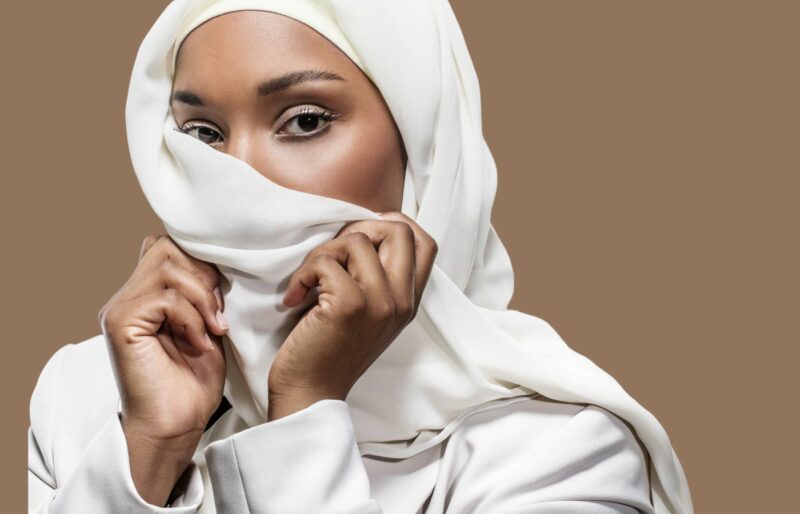
“How do I look?” is perhaps the most common question women ask themselves before leaving the house. It’s not about beauty; rather, it’s about finding a balance between thinking, “I hope it’s not too much,” and “I hope it’s not not enough.“
Almost 170,000 years ago, Sapiens started covering themselves with animal skin and plant-based material for the sake of survival. Then with the rise of patrilineal societies, clothes’ function evolved along with their form, eventually becoming a signifier of identity in terms of social hierarchy, sexual regulation, lineage legitimacy, and patriarchal authority. Gradually, clothing that was once a means of survival turned from a signifier of identity into a marker of morality and social scrutiny for women as patriarchy rose across early civilisations.
A woman’s clothing has often not been a personal and aesthetic choice. What is sold under the guise of religious obligation turns out to be a cultural norm, and cultural roots are more often planted in nationalist identity. Today, veiling is linked with Islam, but it dates to pre-Islamic societies, where elite free women used to practise it to separate themselves from slaves and low-caste women. As Islam came, veiling got associated with purity, which later evolved into sexual propriety and gender segregation, empowering patriarchy by limiting women’s presence in public spheres of life. Then imperialists used the same veil — now a symbol of oppression — as a justification for their civilising mission. As an object holding multiple interpretations and symbolic meanings, a veil cannot be reduced to binaries like oppression vs emancipation.
Centuries later, we witness one of its worst forms in the algorithmic era, where social media amplifies judgment. Particularly in Pakistan, centuries of patriarchy shaped culture and religion into rigid forms, further entrenching what remained during the colonial era. When women dress up, not only do men scrutinise them, but other women with deeply internalised misogyny also pass moral judgements. Even in supposedly neutral spaces, no one can predict how a woman in certain clothes will be judged. So, it is incumbent upon women to silently assess before facing a world ready to label them either as immodest and vulgar or submissive and conservative. In Discipline and Punish, Michel Foucault’s theory of social surveillance argues that when individuals know that they might be monitored by authorities, they begin to regulate their own behaviours and internalise surveillance, making external control unnecessary. For a woman, self-regulation starts with the mirror in her room.
Judith Butler states that “Gender is a performance,” and that performance is expected to follow societal expectations tied to the assigned sex. Clothing is also a part of that performance, and when ripped off choices and forced into identities that amount to little, women often find themselves resisting through their clothing styles in covert and overt ways. A recent example is #MyStealthyFreedom, started by an Iranian journalist, Masih Alinejad, in resistance to Iran’s compulsory hijab laws and moral policing. In contrast, Malala Yousafzai presents herself on world platforms draped in a dupatta, including being featured on a Vogue cover, challenging the Western worldview that believes that all women who wear dupattas or wear abayas are oppressed, conservative and worthless.
Modesty in clothing is also considered related to safety and protection from the male gaze and predatory behaviour. When men commit crimes against women, this same mentality cultivates a culture of victim-blaming. Even though various psychological and criminological studies and research have proven that rape acts to assert power and exert dominance, rather than fulfilling sexual desire. Yet, the majority still believe that rape can be prevented by the right choice of clothing. This belief ignores the fact that no outfit can prevent someone from committing acts of violence if they intend to do so. This mindset turns women’s clothing into a tool that keeps them in constant fear and scrutiny, thereby controlling them.
An article of clothing is not only limited to being a symbol of either oppression or liberation. Agency is much more complex than only resisting the social norms. Society’s insistence on judging women’s clothing choices denies them this complexity. Perhaps the problem was never how women dress, but the mindset that imposed a disproportionate weight of morality upon it. So long as the perspective of eyes — setting upon women already intent on finding an ethical lapse — doesn’t change, the tightrope will remain firmly in place.