





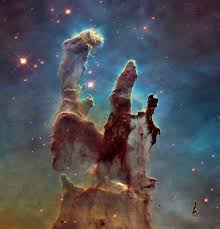
Located around seven thousand light-years away from Earth in the constellation Serpens, the Pillars of Creation stand among the most iconic and breathtaking structures in the night sky. They derive their name from their towering appearance. The Eagle Nebula, also known as Messier 16 (M16), is home to these massive columns of gas.
It is a vast cloud of interstellar material where new stars are still being born. In reality, they are massive clouds of interstellar hydrogen gas and dust. They are carved by intense radiation and powerful stellar winds from nearby stars. These pillars are about four to five light-years long, which means that if we travelled from one end to the other at the speed of light, it would take four to five years.
These structures are in a constant state of change. Powerful ultraviolet light from distant protostars gradually wears away the gas and dust, making the material photoevaporate over time. When observed in visible light, the pillars mirror dark shadows standing in front of bright, glowing clouds of gas. However, astronomers observe them using near-infrared light, which effectively clears away the thick dust, revealing many previously hidden stars.
Astronomers have found denser pockets of gas inside the Pillars of Creation. These pockets are called evaporating gaseous globules (EGGs). These EGGs act as potential incubators for new stars. Under the right conditions, gravity causes these dense knots to contract and eventually ignite nuclear fusion, leading to the birth of suns deep inside the pillars.
The Pillars of Creation are momentary. These structures may only last a few million years before being dissipated. The process that enables star formation also erodes the pillars through intense radiation and powerful winds. Other than their breathtaking appearance, the Pillars of Creation serve as a natural laboratory for studying star formation.
Astronomers study the interaction of shockwaves, magnetic fields, and radiation pressure to determine whether the gas clouds will collapse or disperse. Researchers study pillars of creation across all wavelengths. This helps them understand the equilibrium that governs stellar evolution.
All in all, the Pillars of Creation highlight that the universe is both spectacular and dynamic. They will serve as a reminder of how stars are born, and cosmic forces shape their surroundings. Even though they are not eternal, they will continue to inspire awe and curiosity about the veiled wonders of the cosmos.