





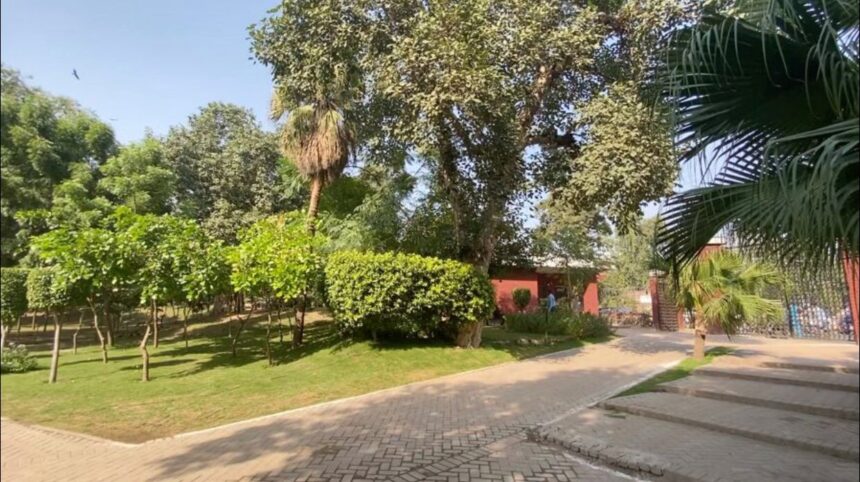
It is in the very middle of Lahore, where a homelike green enclosure has turned into a place of a bigger discussion of progress, remembering, and misplaced priorities. The breathing space of an already overcrowded city, Nasir Bagh, is being transformed into a parking plaza dedicated to a dead man, an icon of what the modern city renewal usually calls upon.
The proponents of the project position it as an interim measure to solve an escalating issue. The neighbourhood is faced with traffic jams, parking violations and disorderly streets. They say that the underground parking plaza will facilitate the flow of traffic, lessen the congestion along the road, and make a city that is already overcrowded look more modern. In this dream, vehicles are buried underground, roads are opened up, and Lahore is a little nearer to the realisation of the smart-city dream — even the electric vehicle can indicate some advancement.
However, the opposition has a different picture. Nasir Bagh is not a blank site that requires development; it is a stratified open area that has been built up over years of operations. Students were sitting under its trees, families were sitting under them, and passers-by could find some relief from the concreteness and noise. A parking plant will take its place — some smooth, it is true, but still a parking plant — to me, renewal seems like erasure.
Loss of trees is the most evident trade-off of this trade. Mature trees do not act as decoration; they breathe life. They facilitate cooling, absorb pollution, dampen sound and provide protection in a city where heat and smog have become the order of the day. It is not possible to replenish saplings in other areas because it will not take decades to regenerate. To a good number of residents, the pruning or moving of trees is a short-term solution that is set to pass as a long-term strategy.
The emotion behind the backlash is well encapsulated in the concept of replacing trading trees with Teslas. It is an appeal to an urban ideal which places the car, usually the property of a select few, above community areas frequented by the multitude. In a metropolis where people are forced to fight over the availability of proper foot pavement and public transportation is still tense, the high cost of parking begs the question of whom the development is actually targeted at.
Another underlying issue brought about by this controversy is the lack of connection between people and planners. Urban renewal, when done without consultation, creates resentment. The meaning of shared spaces that are assigned to them daily is rarely taken into consideration in decisions made in offices.
The changes that have occurred have caused citizens to feel like spectators to the changes that transform their individual neighbourhoods.
The controversy of the Nasir Bagh Memorial Parking Plaza is not only concerned with the location. It poses a question of the type of future that Lahore envisions for itself. A city that reacts to the congestion by excavating deeper to fit the cars, or a city that preserves the green space and reevaluates mobility in general? The real renewal must not entrap the lives of people in concrete but enhance them. Otherwise, things are going to go forward like the word loss.