





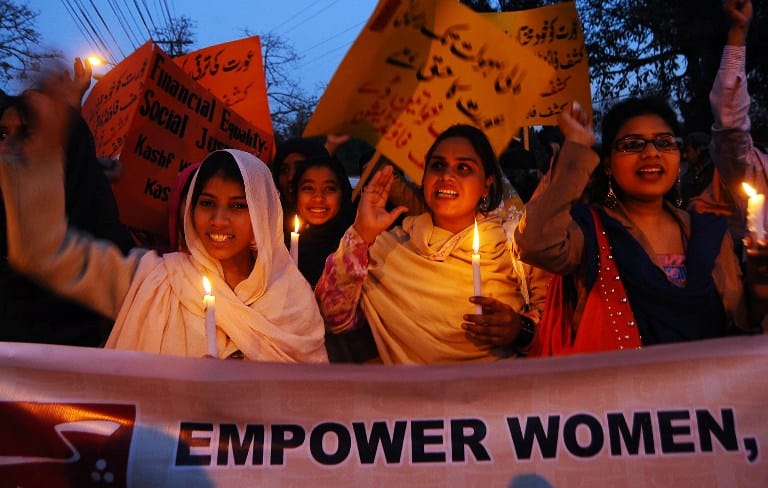
Pakistan frequently emphasises security and protection. Politicians call for women’s safety in the country in their speeches. Laws are passed in the name of women, committees are formed solely for their protection, and press releases circulate. And yet, when it comes to global assessments that measure how safe the country is for women, Pakistan unfortunately hovers near the bottom, a number that should provoke outrage among the masses, but instead, it’s barely acknowledged as a national emergency.
Being ranked so poorly in the protection of women isn’t an accident; it’s a repercussion. The repercussions of neglect, denial, and security legislation that was never designed to cater to women.
Safety That Neglects Half of the Population
When we discuss security in our country, it rarely refers to women walking home at night, having the privilege to travel alone, domestic violence survivors trying to file FIRs, or girls navigating public transport and workplaces.
A country cannot claim to have security when half of its population has to proceed with every movement while measuring the risk of anything and everything they do. Yet this calculation is second nature for women. What time is it? What am I wearing? Who will be there? Is it worth the trouble if something happens? While people disregard this consciousness as paranoia, it’s preparation for the worst.
The Myth of Protection
Pakistan, as a society, holds pride in being protective of its women. Families insist on making their women stay indoors for safety. While safety clearly isn’t in being invisible. Institutions such as schools and colleges force restrictions on females, which they validate under the name of security. But protection at the expense of protection isn’t protection; it’s control dressed as care.
If women were truly guaranteed protection, they wouldn’t fear reporting violence. They wouldn’t be interrogated for surviving it. They would not have to choose between silence and social exile. They won’t have to fear being seen as a criminal when they are, in reality, the victims.
A female being told to “stay home to stay safe” is like admitting the failure of society. It means that the state has outsourced its responsibility to families, and families have responded by shrinking women’s lives instead of expanding safety. And in the end, a woman realises her only mistake was to be born as a woman.
Where the System Breaks
If you are a woman, why does security fail them? The answers would be painfully similar.
At police stations, complaints from women are disregarded. In hospitals, survivors are treated with suspicion and distaste. In public spaces, where harassment is normalised, and reporting is discouraged.
“I knew no one would help,” says a university student in Islamabad who chose not to report stalking. “And I didn’t want my life to become harder than this.”
The contemplation of whether justice is worth the cost of humiliation is the clearest indicator of a broken system.
Safety in the Absence of Accountability
Pakistan’s ranking isn’t just about crime rates; it reflects a deeper absence of accountability. Perpetrators expect amnesty, and the majority of the time, they are proved right. When consequences are rare, violence becomes a routine.
Security is not the existence of legislation; it is the surety that these laws will be enforced and implemented because in the absence of enforcement, safety becomes theoretical — something always put into words and talked about but always absent in daily life.
The state cannot keep asking women to be strong while refusing to be responsible.
The Cultural Alibi
Culture is often the target of blame as an excuse. “That’s just the way society is.” “These things take time.” “You must be realistic.” But isolation isn’t part of culture. It is shaped by what accountability bodies tolerate or punish.
When harassment cases don’t earn women justice, the culture learns indifference. When survivors are shamed, culture learns silence. When perpetrators walk free, culture frees them untainted. Security rankings don’t address danger but what a society deliberately disregards.
What Real Protection Would Look Like
Real protection would not require women to disappear. It would require systems to show up. It would mean police trained to respond, not deflect. Courts that prioritise gender-based violence cases. Public transport designed with safety in mind. Workplaces that enforce harassment laws instead of hiding violations. Most importantly, it would mean shifting the burden of safety away from women and onto the state, where it belongs.
A Ranking We Should Be Ashamed Of
Being ranked near the bottom globally for women’s protection is not just an embarrassment; it is a moral failure. It tells us that despite decades of rhetoric, women remain collateral damage in national priorities.
Pakistan cannot claim progress while women live in survival mode. It cannot speak of security while mothers warn daughters to endure instead of report. It cannot celebrate laws while women know those laws will not protect them.
Until women can move freely, speak safely, and seek justice without fear, no ranking will improve, because no ranking is the problem. The problem is that women’s safety has never been treated as real security.