





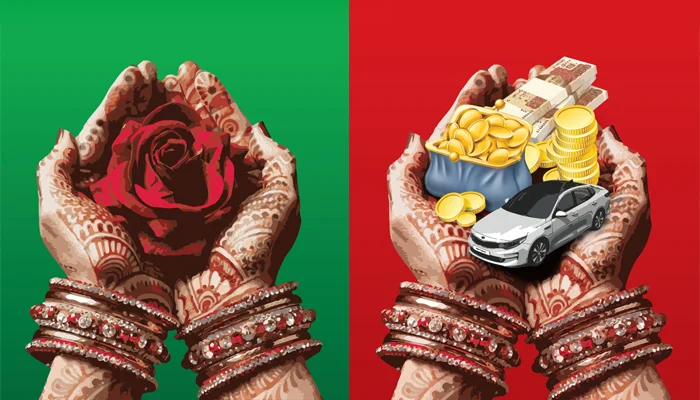
Historically, India and Bangladesh have undeniable tensions with Pakistan. The clash of ideologies has truly stained our history with relentless bloodshed. However, we may be overlooking the similarities that exist between us.
Most prominently, it includes the tradition of dowry. According to Merriam-Webster, “dowry” refers to the money, goods, or estate that a woman brings to her husband as part of her marriage.
It is a tradition that unites these regions, fostering a bond that is built on years of relentless and persistent misogyny.
Marriage: A Luxury for South Asian Women
For every individual, marriage is where we find ‘the one’ with whom we share our lives. Amidst all the chaos in this world, someone becomes a witness to our every version and is with us in every turmoil and success. Yet perhaps it is a luxury for a South Asian woman to experience such companionship.
All our lives, a woman is told to eat, drink, sleep, study, dress up, and even talk acceptably so that she can be fit for marriage. It’s absolutely barbaric that a woman is supposed to design her life for her to find a ‘partner’ — who treats her like anything but a partner.
The Auction of the Daughter
But what’s more bizarre is the fact that even after all the careful planning in her life, the practice of demanding and expecting bride prices is acceptable, and it is even considered honourable for the bride’s family to give as much as they can, even if it practically deprives them of any assets and financial security.
Dowry is not just a box of gifts. It is an economic pressure point, a social expectation, and, for many women, the first lesson in learning to resent their own womanhood.
You might have heard and perhaps seen how mothers — ever since their daughters are born — start collecting jewellery and clothing so that she can be sold, given to the highest bidder, in an auction where she is the product and the one who pays as well — partly with money but mostly with her soul and spirit.
Internalised Misogyny and Mental Health Consequences
These women realise early on that being a girl costs money; money that is given to others for her to get married — apparently, she is a ‘burden’ that requires a payment to safeguard the groom’s security!
This breeds resentment — not just towards society but towards her own womanhood. Early on, a young woman discovers the connection between her marriage and her own thoughts, passions, dreams, and even happiness. Her parents value her marriage based on how much they can afford to give her away. This lifelong programming leads to low self-esteem, anxiety, and even depression. A deeply rooted misogynist society manufactures an apparent honour that leaves her overall mental well-being and happiness behind.
Marriage becomes impossible
What’s worse is that around 10 million women in Pakistan stay unmarried, all because of dowry. They are not unmarried by choice but because the financial burden has made marriage inaccessible. This is especially common in rural areas, where poverty and ignorance are prevalent.
The groom’s family delays or denies the proposal just because the bride’s side gave them a motorcycle instead of the latest model of Toyota, a car which even their generation can’t afford to have. The bride’s family, who are unable to fulfil these expectations, watch their daughters grow old, discouraged and insecure, trapped in their homes as their ultimate purpose of life, marriage, remains unfulfilled.
What could have been a union of love apparently becomes an unaffordable luxury.
Yet, even when dowry becomes accessible, the horror doesn’t end, but rather, in most cases, it amplifies.
The Violence It Normalises
The dowry system has a violent underbelly — one which is often overlooked or silenced in the name of sabr or ‘shohor agar marta hai tou pyaar bhi tou karta hai’. Once a woman is married, her only security is through her husband, who often is the one from whom she actually needs security. Many women face psychological abuse, a constant threat of divorce and even murder over dowry disputes. Some are beaten, burnt, or killed — and labelled as accidents or suicides when the bride’s family fails to deliver more.
“Dowry demands are usually settled at the time of marriage. However, some men and their families continue to make dowry demands throughout the marriage,” said Human Rights Watch, suggesting how the want for more is never ending.
According to Pakistan’s News International, an English-language newspaper, the country has the highest reported number of dowry death rates per 100,000 women in the world, with an estimated 2,000 cases reported each year.
How bizarre is it that a tradition that treats women as commodities and then sells them to a family whose needs only end when the girl is dead is considered honourable?
The Familiarity, Privilege and Responsibility
I am confident that for most of you, reading about this subject is not new. You have heard it in a family gathering or perhaps have seen it in a Pakistani drama or in movies like Load Wedding, highlighting the brutality of dowry.
But perhaps what you can take away from this article is the realisation that we have a responsibility.
For women like me who are privileged, we might not realise its severity. This is not due to our inability to comprehend misogyny, but rather because it has become ingrained in our lives.
Despite the weight of this tradition, our families have evolved with time, by the grace of the Almighty, quietly and steadily. Through social media, many people have gradually become more aware of the cultural hypocrisy behind dowry, with people realising how Islam forbids the demand of dowry.
We might not personally know the women inflicted with this barbarism, but their fight is ours as well. You see, the difference between them and us is only pure luck. Our destiny chose to be at our side, but our responsibility remains. We need to fight back even though we might not experience what our ancestors did, and so do many women around us. We are all part of the same society, and what are humans without one another?
Therefore, learn, be aware and spread awareness not only through social media but also through sparking conversations with people around you. You can also convince the local masjid and imam to educate people regarding the subject.
Because the price of this tradition is simply too high, the entire lives and even deaths are consumed by all in the name of ‘marriage’. We cannot let such traditions ruin such a beautiful union just because our society can’t stomach a happy woman.
It is time to stop paying this price.