





You once had a rendezvous with pain. At that time, it was only an abstract concept. You touched it back and forth until your insides were opened up by that touch. Your pain became palpable. That bruise transformed into an abscess as autumns transcended into searing winters. The question is, when to stop fostering pain? The answer is simple: every time it pains.
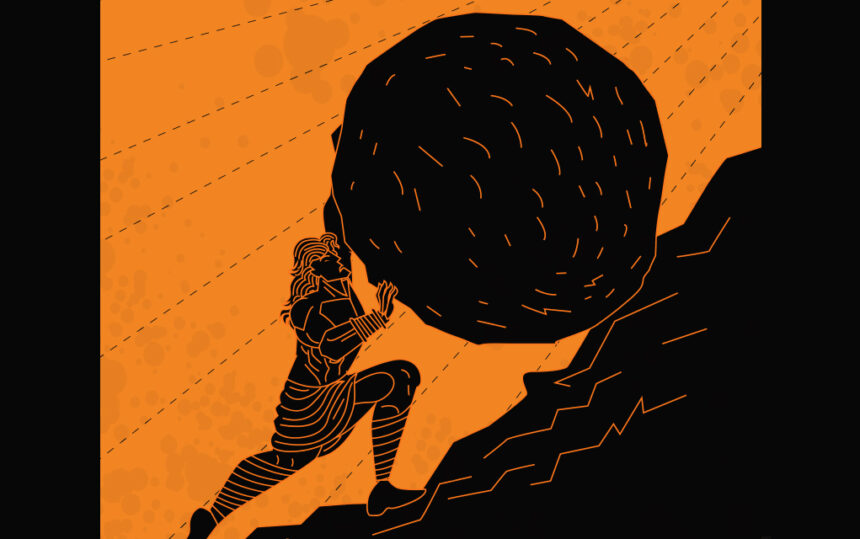
In theory, each time a struggle ensued, Sisyphus adamantly intellectualised and reinterpreted it. Like a ritual. It became an integral part of his identity. There is an old idea in philosophy that in order to live well, one must struggle with heroic defiance, and our modern world also repeats the same mantra: keep pushing and do not quit. But no one tells us, till when? People rarely question the psychological and ethical absurdity of glorifying perpetual struggle. Camus’ Sisyphus stands at the heart of existentialist mythology as he perpetually pushes his boulder uphill, only for it to roll back down. Camus famously concludes, “One must imagine Sisyphus happy.”
Why must we?
The Anti-Sisyphus rejects this coerced form of imagination and dares to reflect on what Camus avoids: Perhaps Sisyphus is trapped, and there is nothing so transcendental about his plight. In more ways than one, Sisyphus closely resembles what Byung-Chul Han calls the ‘’achievement society.’’ The concept describes a world where an individual is both a slave and a master, continually self-disciplining in the guise of productivity. In this sense, the burnout culture we have today is nothing but a digital boulder that we roll daily while motivational speakers repackage our tiredness as ambition.
With regards to classical existentialism, disengagement from a goal is misinterpreted as cowardice, but cognitive psychology tells another story. In essence, the compulsive repetition of pain leads to fixation, which, from a psychoanalytic perspective, manifests as repetition compulsion. This can be simply delineated as a form of self-infliction. The act of relentlessly pursuing a path that lacks logic leads to a dependence on appearances and routine, with the belief that if you persist in your mindless efforts, something positive will eventually emerge. This approach is a collision between futility and insight that often results in nothing.
The ancient Chinese philosopher Zhuangzi writes about the ‘usefulness of uselessness’, a bludgeoning paradox that states that one also ought to step away from the structures of effort so that newer perspectives can emerge. The concept suggests that it is possible to be unconventionally useful while still achieving your maximum potential. However, in Sisyphus’ case, it is juxtaposed because he is being destroyed by virtue of his usefulness, as he is productive in the most meaningless manner. In contrast, the anti-Sisyphus stance reveals a radical idea: that perhaps the most philosophically meaningful act is to stop.
Relatively, the existentialist tradition surrounding Camus often assumes that rebellion is noble. In this view, what if rebellion against fate is still a form of obedience? The Buddhist perspective of the Dukkha reveals that suffering is not essentially born from pain but from our clinging to pain. Ergo, the bruise becomes an abscess not because the pain was inflicted once, but because we kept revisiting it.
When Franz Kafka created characters that were trapped in meaningless systems, like Gregor Samsa or Joseph K, he anticipated the Sisyphus predicament before Camus even articulated it. In Kafka’s universe, his protagonists were swallowed by labyrinths that offered no reward or transformation. In The Trial, K. dies without understanding the charges. In The Castle, the protagonist is lost in contradictions. In The Metamorphosis, Samsa continues to work even after transforming into a vermin, suggesting that his sense of obligation surpasses everything, including his humanity. In this context, the Anti-Sisyphus rebels by simply walking away.
From a behavioural neuroscience perspective, chronic stress as a result of ongoing struggle rewires the neural pathways of the brain. Maurice Merleau-Ponty seconds this idea in his phenomenological work by asserting that bodies are not merely a tool of experience or experimentation but also the very ground for meaning. So one must listen to the body, if not the mind. It is our job to understand that hustling is not always resulting but also restricting; thus, cessation is not necessarily defeat.
On a rather contrary note, Sisyphus’ culture is akin to the Western theorisation of the Orient. The way the West has fashioned us into a convenient intellectual object, made concepts out of us, and exoticised our stories and then channelled them onto the world. They make ideologies and phenomena out of living, breathing humans and make them look like an abstraction. A concrete abstraction that must be manipulated endlessly so that it can produce monetary benefits.
Similar is the Sisyphean loop: to convert humans into a spectacle. The individual becomes secondary, and his resilience is romanticised without acknowledging the systemic trap. Perhaps John Cassidy’s Sons, Departing fits this narrative the best, as he captures the precise violence of abstraction and the aesthetic of dehumanisation, where people are treated as agencies of endurance, flattened into a collective silhouette.
To say, the anti-Sisyphus teaches us that the measure of a meaningful life resides in the courage to recognise the futility of struggle. Systems, whether they are capitalist, institutional or cultural, have long benefitted from this celebration of resilience, and it’s about time we stop fuelling it. After all, being annihilated by grotesque passion is not as admirable as we have been taught to believe.