





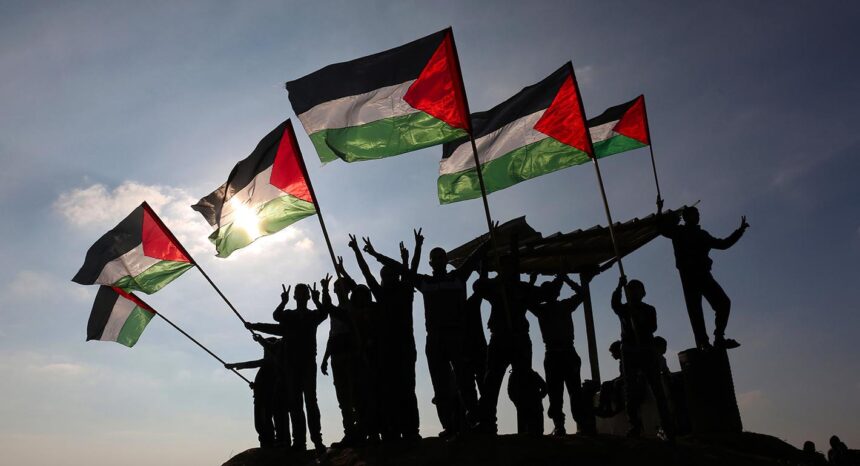
Aditi, a young blogger in Mumbai, was scrolling through her feed when she came across an ongoing Palestinian movement and changed her profile picture to “Free Palestine.” By the next morning, her account’s reach was significantly reduced — she realised she had been shadow-banned. Curious, she delved deeper and was shocked to discover her government was openly siding with Israel. That moment of disbelief was something she had never felt before. She grew up believing her nation was always on the right side of history — cheering at every victory, defending every stance. But this moment left a wave of doubt in her — was her loyalty to her flag or to her conscience?
Billions around the world have experienced these small fractures in their patriotism at various points, with similar yet distinct reasons.
Aditi still sang “Jana Mana Gana” standing up straight with a hand on her heart, but now there was a heaviness of uncertainty that trembled beneath the chorus: what does it mean to love one’s country?
What is patriotism and the love for one’s country? A country marked by crooked lines on a map acquired by people generations before us in exchange for their blood and sweat. Does this sacrifice of people hundreds of years back make every human being born in this piece of land, secluded from the rest by barbed wire, hum its anthem — irrespective of their knowledge of the ideology of the state, irrespective of if the state itself abides by its ideology? This is a question that not only haunts Pakistanis or Indians, but it lingers in the marrow of the hearts from Islamabad to Istanbul and Karachi to California.
Patriotism fatigue reveals itself not in rebellion, but in quiet reorientation. The loyalty of this generation is directed less by passports and more by principles, less by the pride they inherited and more by the conscience they’ve cultivated. It isn’t apathy; it is the thinning of the concept of deriving meaning from governmental agendas and activities, irrespective of whether any of it bears fidelity to morality.
The anthems still echo, but all the value the words hold is merely ornamental. Across continents, crowds painted in their flags’ colours fill the streets on national days, but the paint fades faster than the fireworks they light. On ordinary mornings, nobody speaks of the country unless it is to curse the power figures or inflation rates. The pride that used to be in the heart of a common man is replaced by fatigue dresses as detachment, and all that is left of patriotism is a loud, momentary, and hollow performance.
Freedom of speech, though promised, is often selectively granted. The media houses across the globe are advised early on what not to air if they wish to stay on air. Anchorpersons learn to navigate the boundaries, expressing just enough information to appear independent, but never enough to provoke authority. When a channel questions too directly, its signals flicker; when a journalist writes too honestly, they learn that truth has a cost, sometimes exile, sometimes life itself. Thus, when the mainstream media begins to echo victories and bury flaws, while social media provides an opposite lens to reality, what would be left of credibility and trust in the end? In a society where open critique leaves you unsafe, where questioning is forbidden, even love begins to shrink.
The constant insistence on pride, be it in morning assembly or state-sponsored events, creates a numbness rather than allowing the love for homeland to bloom naturally by the policies the country makes, the stance it takes on global issues, and the history it has written and the one it writes in the present — hence losing the melody like some overplayed music.
Today’s hyperconnected world is blurring the boundaries between “us” and “them”. The generations of today see the world as one shared ecosystem — of humans and the shared truth. When Amy from Chicago shares the same moral beliefs as Fatima from Tehran, what separates them is merely the latitude beneath their feet.
It is a global phenomenon; people in most parts of the world staunchly believe there are better opportunities out there in the world than what their homeland offers. The weight of this widespread aspiration, which often remains unfulfilled due to familial commitments, expenditures and whatnot, adds a wave of halt to uncritical nationalism. Inflation, corruption, hypocrisy, fear and fatigue act as the final nail in the coffin.
Buried in the ruins of fading pride, there is still hope. Disillusionment, after all, is actually evolution. Every generation must rewrite the answer to the question: what does it mean to love one’s country?
The antidote to blind patriotism isn’t apathy; it’s empathy. The foremost step to bring back the emotion and the spirit is honesty. Brutal honesty. Allow humans to practise their innate right of voicing their questions, opinions, and reservations — both publicly and privately. Value the votes people cast, and appoint the leader they elect. Educate the upcoming generations with raw history that speaks bluntly of both the triumphs and the failures of the state, government or army.
And perhaps one day, when truth is no longer feared and love doesn’t need to be performed, patriotism will find its way home — nurturing itself not on slogans, but on integrity. A day must come when the anthems echo understanding and not obligation. When trust is restored in ways as quiet as a fair headline, a just verdict, and an act of service without a ribbon-cutting ceremony, and when loads of these acts gather, they will weave back the tapestry of love and trust until the day every Aditi, Fatima, and Charlotte can look up at her flag and whisper beneath her breath, “It is mine again.”
Brilliantly written piece. Raw, honest and true.
Truly powerful work 👏
Powerful reminder that real patriotism grows from honesty not from obligation.
The way you put such difficult emotions into words is brilliant!
This is the best article ever
“And perhaps one day, when truth is no longer feared and love doesn’t need to be performed, patriotism will find its way home”
These lines so well depict our reality
In the current era something like this was much needed kudos to the author