





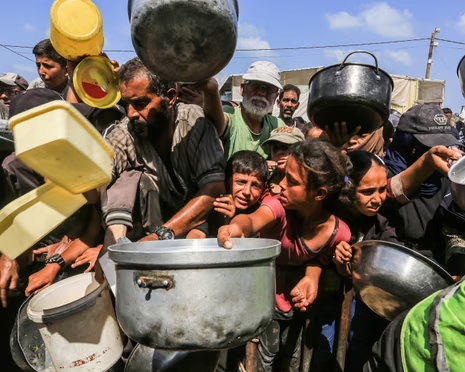
Calculated Starvation of Gaza: In a world defined by innovation, where artificial intelligence has revolutionised every aspect of our lives, one might assume that humanity has also advanced. Yet, today, we find ourselves circling back to witnessing the darkest tools of warfare being used in real-time: the deliberate starvation of the Palestinians.
Internal Israeli government documents and planning records from the Coordinator of Government Activities in the Territories (COGAT) have confirmed what many Palestinians have long been suffering from: the systematic use of food as a tool of oppression. Through a coldly bureaucratic policy, Israel is not only withholding food but also managing, rationing, and restricting it using specific policies and algorithms.
The aim was not to ensure their well-being but to keep Gaza’s population just above the threshold of starvation so that they would slowly fall into deterioration. These are not the conditions of a failed world — they are the symptoms of a deeply functioning system designed to break people without leaving visible scars.
This dystopian logic reads more like The Hunger Games, where food is used as a form of governance and suffering is calculated. In Suzanne Collins’ fictional Panem, the Capitol rations food to suppress rebellion and reward obedience, weaponising scarcity to maintain control. It was fictional. However, in Gaza, it is part of daily life.
The Algorithm of Oppression is Not New
In 2012, following legal pressure from Gisha — a human rights group — Israel’s Ministry of Defence was forced to release the document titled “Food Consumption in the Gaza Strip — Red Lines”, which included an assessment of how much food Gazans need to survive. This policy, implemented between 2007 and 2010, also factored in demographics and local food production to determine the “necessary” restrictions.
The Israeli officials claimed the aim was to prevent a “humanitarian crisis” under Hamas’s internal control of Gaza, but the methods used revealed something far more sinister.
Like always, this was a brutal act of oppression from Israel. It was unjust. It was siege warfare with Excel sheets. Officials disguised it as policy. The media buried it. But the result was unmistakable: hunger by design.
Today, Gaza faces an even greater catastrophe — what many now call the most severe humanitarian crisis of the 21st century. UN reports show that over one million Gazans are experiencing alarming levels of food insecurity. According to the Euro-Med Human Rights Monitor, at least 175 Palestinians have died from starvation, including 93 children, as of 3rd August 2025.
Aid trucks are blocked, bombed, or used as bait — to take more lives. In some cases, air-dropped food aid has reportedly been inedible — mouldy, contaminated, expired, and even laced with drugs to sedate or disorient them, exploiting their desperation as they die from starvation.
A Boy Named Amir
Amir was just a little boy, small and starved, as his bones showed through his skin. He walked barefoot for 12 kilometres under the scorching sun — not to play, not to go to school, but to find food. When he was handed scraps by the soldier, he kissed his hand in gratitude.
Yet as he turned to leave, he was shot dead. His dignity and gratitude, it seems, were a threat.
Tragically, this is not an isolated case — Amir’s fate is one of countless others.
Starvation as a War Crime
Under international humanitarian law, the deliberate use of starvation against civilians is a war crime. And let’s be clear: civilians mean all people, regardless of race, nationality, or geography. The law does not say “white” or “European” — it clearly states all human beings are entitled to protection.
Article 54 of Additional Protocol I to the Geneva Conventions prohibits “starvation of civilians as a method of warfare.” It emphasises the legal and moral obligation to protect innocent civilians during any armed conflict, especially regarding access to essential resources like food and water.
So how does it persist for the Palestinians?
Because legality, like food, is rationed. It is applied selectively. This is because those with the power to act and reinforce these laws are entangled in alliances, arms deals, and political cowardice. The oppression faced by the Palestinians long predates October 7th, 2023 — and yet it is rarely acknowledged as part of the root cause of today’s suffering.
It has led to parents boiling grass to feed their children. It has reformed Gaza to become an open-air prison where the punishment is slow, painful, and lived every second.
Are We Back in the Dark Ages?
It’s a haunting question: With all this innovation and advancement, when did our hearts become dark?
In the age of satellites, biometric surveillance, and remote surgeries, with AI being integrated into our lives, we witness the suffering in Gaza in real time. We know how many are dying. We know how. We have every fact and statistic.
We watch. We scroll past it. We say, “It’s complicated.”
We do nothing.
History tells us this is not new. Entire regions were cut off from food as part of genocidal campaigns, from the Bengal famine under British rule to the Nazi Hunger Plan, which aimed to starve millions of civilians in the Soviet Union to divert food to German troops.
It’s ironic how history repeats itself. And how Israeli people have become what they once feared.
Conclusion
The starvation of Gaza is not just a strategy — it is a moral collapse. Civilians are being reduced to numbers in spreadsheets and reports. But they are not numbers. They have names, families and dreams — just like the rest of us.
Gaza is caught in a merciless design, much like the players in Squid Game who are trapped in a brutal system meant to fail them. But this is no game. There are no winners — only survivors, if any.
This isn’t fiction. It isn’t accidental. It is deliberate. And if we normalise this cruelty, we don’t just lose our humanity — we erase theirs.
The world is a witness to it all.
The only question left is: who will care enough to act?