





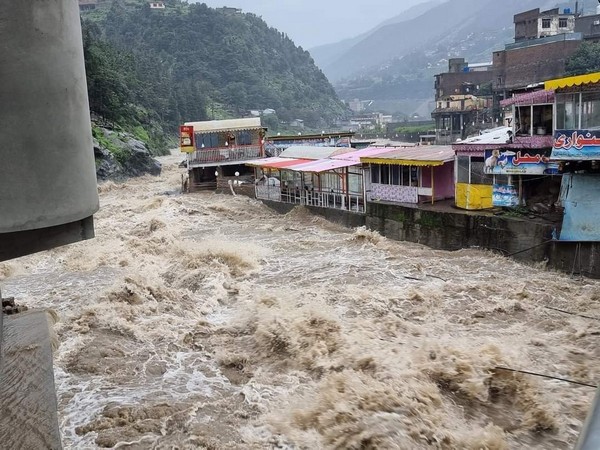
Ignored to Unignored: For years, the areas of Khyber Pakhtunkhwa and Gilgit Baltistan have been plagued by recurring floods. Locals suffer greatly year by year, but the media barely provides any coverage of these floods. However, the floods of 2025 changed the narrative, as upstream flooding also caused extreme devastation downstream.
The recurring devastation
In 2022, intense flooding caused the loss of more than 1700 lives and affected 33 million people. The same situation was also seen back in 2010. Every year, flash flooding affects the region of Khyber Pakhtunkhwa and Gilgit Baltistan because of the heavy monsoon. Climate change has worsened the situation as more glaciers melt due to rising temperatures, and unpredictable rainfall hits the region. Pakistan ranks among the top 10 nations most vulnerable to climate change, according to the Global Climate Risk Index. The region’s unique mountainous and steep topography further intensifies the effects of flash flooding. Every year, because of these floods, the locals lose their lives, their loved ones, and their homes. However, their sufferings remain neglected, and they are barely provided with any news coverage or help, as these losses are considered “local” and therefore acceptable.
The Turning Point — The Floods of 2025
As floods hit this year, their effects reached downstream as well, causing enormous devastation. Over 1000 individuals lost their lives, impacting approximately 3.02 million people. It was impossible to ignore these catastrophic floods, and the plight of KPK and Gilgit Baltistan finally became apparent. The floods showed how flooding upstream in the mountains directly causes devastation downstream as well.
“If the glaciers of the Himalayas melt, no wall can hold back the flood,” said Imran Khan 5 years ago.
We are now witnessing what he warned us about years ago.
This was not just a flood. It wiped away villages, destroyed homes and took away countless lives.
“We had never seen such a disaster before in our lives. The flood came with such force and speed that it washed away everything in no time — our homes, our villages, our loved ones. We couldn’t do anything. Now we are stranded in debris- and mud-filled areas, trying to survive,” said a survivor of the 2025 floods from Buner, KPK.
The Need For Immediate Action
The 2025 floods have shown us the cost of negligence. We can no longer ignore or stall this issue. We can’t just stop floods, but what we can do is take precautions and try to mitigate their effects.
The first and foremost step is to follow laws like the “River Protection Act” (This law prohibits construction within 200 ft of a river or its tributaries). Many such laws go ignored, as many argue that these laws are erasing villages on riverbanks that have existed for centuries. That might be true, but centuries ago, climate change was not such a major issue that it would cause monstrous floods like these. We can not simply end climate change, but we can at least try to take steps to mitigate its impact.
“We are suffering from it, but it is not our fault at all,” said Prime Minister Shehbaz Sharif about climate change, indicating how we are the victims of climate change that has been caused by the so-called ‘Donor Countries’.
We can’t just implement laws to stop these countries from emitting dangerous amounts of greenhouse gas, but what we can do is implement laws in our own country to reduce the emission of greenhouse gases. We as a nation should stand together, united to face these floods along with our fellow brothers and sisters and help them, and try our best to take steps to prevent such floods in the future.