





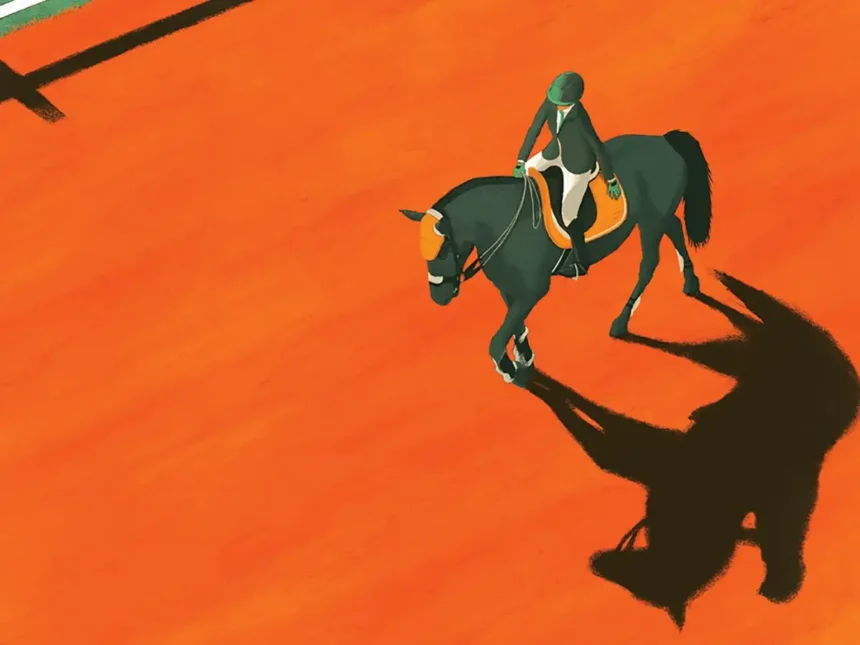
What if the horse animal you cheer for in the arena is the same one doped, whipped, and discarded once the cameras turn away?
Let’s begin with the silence.
The only sounds to break the silence of the show ring were well-timed hoof movements and courteous applause. Horses trained to obey rather than trust are surrounded by shadows in the too-silent, too-clean barn corridors. The industry’s quiet is deliberate, manufactured, and dangerously courteous.
Something more profound lies behind each broadcast leap, paused playback of a gallop, and a satin ribbon. In this sense, horses are instruments, designed for performance rather than enjoyment; they are not athletes. The severity is not a coincidence. It is refined, practised, and transmitted.
And whether you know it or not, you’re a part of that silence if you’ve ever applauded from the stands or enjoyed the sport’s glitz without considering what goes on behind it. This isn’t an exposé meant to defame a sport. This is a call to face it.
Where Training Turns into Torture
The lie begins with the word ‘discipline’. The belief is that the horse’s spirit must be tamed. Building trust is the aim of authentic training. But that’s not usually the objective.
Take rollkur, which causes the neck of a horse to coil abnormally. Supporters call it “stretching”. Actually, it collapses the horse’s usual line of sight, compresses his vertebrae, and replaces equilibrium with fear. Indeed, it is forbidden in a competitive setting. Nevertheless, it is carried out covertly, behind the closed doors of elite training facilities.
Consider the bit, the spur, and the whip. Although they are not dangerous by nature, they can be disastrous if used improperly. The purpose of these tools is not to guide but to punish. You can see the indicators. The head of a horse is thrown back. Avoiding a jump. The horse may shudder, stop, or freeze. These symptoms are not the result of disobedience but of fear.
Additionally, lunging is a harmful technique. A young horse may become tired when driven in circles. Legs are still growing. The joints were stretched. The body bends before it even learns to balance. This is promoted as tradition as well.
Is this not the cruellest truth? This is not unusual. This situation is the norm in many barns.
Competitions: Where the Velvet Curtain Falls
There is an illusion of grandeur in the arena. The glitter of medals and ranking systems conceals the unspoken reality that horses weaken under stress.
The demands are harsh: on-time obedience, beauty, speed, and power. The system doesn’t move when the horse resists. It’s filled with medications.
Doping is widespread. The purpose of sedatives, stimulants, and painkillers is to perform, not to heal. Sometimes legs are sprayed with capsaicin, which is made from chilli peppers, to make it too painful to refuse to jump. These methods are rarely observed. Timed administrations, insider knowledge, and microdoses buy time until a scandal occurs.
But horses suffer in silence long before the news. Spinal injuries, tendon ruptures, and lung haemorrhages were all hidden until collapse. What time does the show end? They vanish. Silently sold. Put up for auction. Taken to the slaughterhouse.
They disappear in the same manner that their pain was lessened: away from the camera.
Love Is Not Protection
People who ride horses will tell you how much they love them. Maybe they do. But love turns into a privilege when money and medals are involved.
When a beloved horse begins to perform poorly, what happens? At what point are sponsorships in jeopardy? Love is normalised. Chilly. Conditional.
We need to consider whether we are utilising or valuing horses’ abilities.
The Quietest Cruelties: What Happens After the Applause
Not all damage can be heard. It is not always the case that abuse looks like a strike. Carelessness can result in some of the most serious injuries under the pretext of habit and prestige.
Horses are social creatures by nature; they are made to roam, interact, and graze. Many, though, spend up to 22 hours a day behind bars. Some are undernourished. Others receive excessive amounts of food and supplements. Hooves are not clipped. Untrimmed teeth. Minds that are not stimulated.
What about the circuit’s stars, the “lucky” ones? They are also image prisoners; they are kept clean, given medication, fed according to strict timetables, and denied the basic pleasures of exercise and dirt. They’re dressed up, but they’re very sick.
“Retirement” is an unattainable goal. Many former athletes are sent to slaughterhouses abroad and end up at auction houses. Ignored.
So Why Don’t Things Change?
This is because customs tend to protect the abuser rather than the victim. Trainers are taught to submit to coaches, and riders are taught to submit to trainers. It is considered disloyalty to speak up. The hierarchy is spared, but the horse suffers.
Because dissent is suppressed by money. A successful horse generates sponsorships, breeding agreements, and social capital. Who wants to risk an uncomfortable eye or a bruised joint?
Institutions prioritise reputations over facts. Rulebooks are unclear. There is little testing. Transparency is not required.
Thus, the violence becomes ingrained in the culture. Inherited. Learnt. Reasonable.
Breaking the Cycle: A New Definition of Success
Medals are no longer necessary. A new moral standard is required.
- Prohibit cruel behaviour.
- Require welfare training for all riders and coaches, not just the less experienced ones.
- Implement stricter anti-doping regulations with tangible consequences. Rethink success by prioritising harmony over power.
- Performance is subordinated to partnership.
Silence made cruelty invisible. Speaking — through reform, resistance, and care — is how we break it. If equestrian sport is to survive with dignity, it must choose the horse over the spectacle and the partnership over the prize. That is the only legacy worth applauding. If horsemanship means loyalty, then the truest riders are those who stand with the horse when the crowd falls silent.