





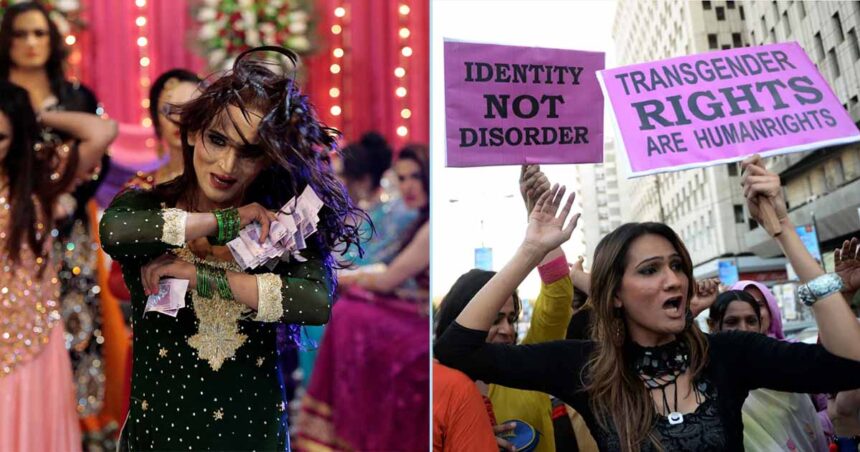
In 2018, the Pakistani Parliament passed landmark legislation, the Transgender Persons (Protection of Rights) Act, commended as one of the most progressive laws in recent years within the South Asian legal framework. Yet, seven years later, the roots of the key protection afforded by the act to the transgender individuals, often referred to locally as the ‘Khawaja Sira’ community, have eroded, not only through political inertia or religious opposition, but also through major rulings of the Federal Shariat Courts (FSC), the constitutional Islamic religious court of the Islamic Republic of Pakistan.
The Transgender Persons (Protection of Rights) Act 2018
The bill was first inaugurated in 2017 by the then Minister for Human Rights, Dr Shireen Mazari, in Pakistan’s National Assembly, and became subject to rigorous debates over about a year and a half and was enacted into the legal framework. The statute aimed to provide legal recognition and protection to transgender persons, an idea that remained alien in Pakistan’s legislative timelines. It was voiced for by a broad spectrum of stakeholders, with international recognition by human rights organisations. Human Rights Watch acknowledged Pakistan’s effort, calling it a “milestone in legal recognition and protection for transgender people”, while OHCHR, complimenting the act, described it as aligning with international human rights standards and obligations.
The Transgender Persons (Protection of Rights) Act 2018 marked a significant step towards legal gender recognition, granting transgender persons the right to self-identify their gender in the National Database and Registration Authority (NADRA). It prohibited discrimination in employment, education, healthcare, public services and housing. Furthermore, it introduced the right to criminalise harassment, exploitation and violence, obligating the government to structure programmes to support the transgender community.
Political and Religious Backlash
Soon after the enactment, the transgender community raised their voice against the false propaganda that was unleashed against the Act, and political inertia and opposition labelled the rights for transgender people as a protection introduced for homosexuals.
Maulana Fazal ur Rahman, a prominent religious political figure and the chief of the Pakistan Democratic Movement (PDM), voiced disapproval, arguing the Transgender Persons (Protection of Rights) Act 2018 contradicts the “teachings of the Holy Quran and the Sunnah.” Senator Mushtaq Ahmad Khan, a member of Jamaat-e-Islami, led campaigns to delegitimise trans rights, arguing they promote anti-Islamic values, are “propaganda” promoting homosexuality underpinned by westernisation, and challenge the law in the Federal Shariat Court (FSC).
As Express Tribune reports, Zanaiah Chaudhry, a transgender rights activist countering the criticism, highlights, “There is no mention in this 11-page act that a man can marry another man or a woman can marry another woman.” The deficiency in comprehending the provisions of the Act was understanding it as a promoter of same-sex marriages and a bid to promote homosexuality, but the idea of marriage or homosexuality remains untraceable throughout the statute. Transgender activist Bindiya Rani said that the marginalised transgender community has struggled for years for basic legal rights; the allegations against the Act, she said, would further promote the community’s forceful resort to beggary.
Shahzadi Rai, criticising Senator Mushtaq’s arguments
Shahzadi Rai, criticising Senator Mushtaq’s arguments, highlights that, as per the 2018 Act, transgender individuals will be assigned gender X on their national identity cards, which would obstruct the possibility of same-sex marriage or legalising homosexuality. She further argues against Senator Mushtaq’s proposal of mandatory medical boards to ‘verify’ the transgender person’s sex, comprising multiple doctors and a ‘religious cleric’, which Rai views as an intrusion of privacy and an invasive procedure. She argues against the gender discrimination the senator proposed, as the idea that trans people must ‘prove’ their gender, while others don’t, is oppressive and regressive. Further, her argument rests on the medical oversight as an impractical step. Moreover, The News reports there are more than thirty types of intersex conditions and only one qualified doctor for the 10,418 transgender people in the country, as per the latest census.
How have the limbs of the state gutted the trans rights?
The Islamic Republic of Pakistan is a signatory to important human rights treaties under international law, such as the Convention on the Rights of the Child (CRC), the International Covenant on Civil and Political Rights (ICCPR), and the International Covenant on Economic, Social, and Cultural Rights (ICESCR). These are the most important human rights treaties that address transgender rights, such as privacy protection, nondiscrimination, and gender identity protection. Nevertheless, Pakistan has consistently failed to provide legal protection, despite calls for action from the United Nations’ Universal Periodic Review (UPR).
Such neglect has led to rampant violence. Al-Jazeera reports that between 2015 and 2020, 68 transgender people were killed and 1,500 cases of sexual assault were reported. Further, UNDP in 2023 documented more than ninety-one killings in the province of Khyber Pakhtunkhwa alone. The absence of sanctions for harassment or discrimination in the 2018 Act is the reason why the pervasive violence continues. Additionally, up to 90% of transgender people with denied CNICs and passports were not registered by NADRA as of 2025. Also unfulfilled is the 2% public-sector quota.
Despite such alarming reports and figures, most mainstream political actors either have remained silent or employed strategic distances from the largely controversial topic within the political and societal atmosphere. Instead of mobilising to defend the legislation, activists often find that political parties have largely abandoned transgender communities, leaving them to face legal rollbacks, court battles, and public hostility.
Judicial Dilution
The Federal Shariah Court (FSC) in 2023 struck down three key sections of the Act. Sections 2(f), (3), and 7 about how people identify their gender and their inheritance rights were removed, stating that only the sex assigned at birth should determine gender because it goes against Sharia, which is seen as a backward move for the Act and aligns with what religious scholars want. The Human Rights Commission of Pakistan recorded 72 cases from January 2021 to August 2022, including harassment and violence cases across three provinces.
In May 2023, the Federal Shariah Court (FSC) partially halted the Transgender Persons (Protection of Rights) Act 2018, which spurred violence, discrimination, and abuse. This was a major turn in the judicial attitude towards the rights of transgender persons. Although the Act has since been reinstated, in the face of growing judicial retreat, one of the largest political parties, like the Pakistan Peoples Party (PPP), have voiced their concerns about the fading 2018 Act. The Secretary General, Farhatullah Babar, criticised the court’s ruling, appealing to the highest appellant court, the Supreme Court of Pakistan, as a vocal defender of the fundamental rights of the community.
Conclusion
In conservative South Asia, the rights of transgender persons remain a struggle; despite the Transgender Persons (Protection of Rights) Act in 2018, the taboo and stigma attached to the ‘Khawaja sira’ persists. Legal protection means little, as the political opposition has stripped many of these protections. Seven years later, the attitude of courts and political parties indicates a struggle for legal survival, leaving trans Pakistanis fighting for the rights they were pledged. Despite the challenges faced by transgender individuals, the community and trans rights activists remain resilient, envisioning a more promising future.