





Growing up in Gilgit-Baltistan has never been less than a privilege. Huge mountains surrounded us like guardians, majestic glaciers sparkled under the sun, and our rivers carried life to every corner of our valleys. To us, this land was always our home, our peace, and our security.
But today, when I look around, it doesn’t feel the same. That privilege feels like a fading memory. My home, my people, are drowning, crumbling, and crying out, not even for help anymore, but in despair. Strange as it sounds, many of us have stopped expecting anyone to come.
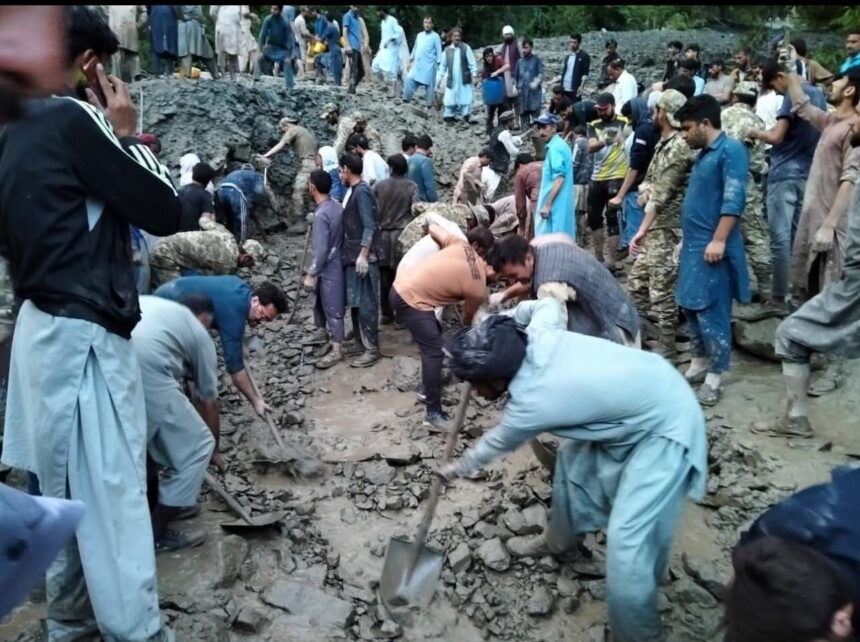
This past summer, climate change took a heavy toll on us. Floods tore through our villages. Unpredictable cloudbursts smashed homes. Landslides cut off entire districts. Rivers overflowed into streets where children once played. People lost their lives, families were left shattered, bridges broken, and roads vanished everything washed away before our eyes. Imagine the trauma that it leaves behind.
Yet, what cuts deeper than this destruction is the silence of those who were supposed to protect us. The ones who brag about our beauty, our landscapes, our people’s hospitality, where are they now? What about the GLOF-II project? What about emergency preparedness programs, disaster management systems, and the huge funds and donations we keep hearing about? We know nothing of them. We are not even given proper media coverage. Sometimes I wonder if we are even considered part of any system, of any so-called government?
Our glaciers feed the mighty Indus River. Our mountains draw tourists from around the world. Our land is situated along the critical CPEC route. We give so much, yet when we bleed. In times of crisis, we are forgotten, unseen, and neglected.
Our helplessness has become our inheritance. We don’t even complain anymore, nor do we hope. We suffer, we cry, and we help ourselves. It has always been this way. Maybe that is why we remain unseen and unheard. We rebuild with our own hands. When roads are blocked, we carve our own paths. When homes collapse, we remake our own walls. When lives are lost, we carry our own dead. We mourn our people and land, and still, we stand up again. It is we who carry us through every tragedy.
Climate change is no longer an abstract threat here; it is our daily reality. Our glaciers the very soul of these mountains are melting at alarming rates. Floods are stronger, rains more unpredictable, winters harsher, summers unbearable. What once felt eternal now feels fragile. But while nature changes, one thing has stayed the same “the cruel neglect of our leaders. Our cries for help are answered with silence, and our suffering is politicized instead of relieved.
Are we not human enough? Do our lives mean nothing? Do our people not deserve more than survival?
As I write this, I can only echo the words of Faiz Ahmed Faiz:
“ہم دیکھیں گے
لازم ہے کہ ہم بھی دیکھیں گے”
“Bol, ke lab azaad hain teray
Bol, zubaan ab tak teri hai.”
Speak, for our silence has lasted too long, and our valleys deserve to be heard.